
I kept noticing the same thing. The Sufi mystic says “I am the Truth” and gets executed. Later interpreters soften it—he meant annihilation of self in God, not identity as God. The Upanishads say “Thou art That,” but then introduce levels of reality, years of practice to realize what’s supposedly already true. Christian mystics describe union with God, intimacy, indwelling—but never quite “I am God.” Always “with,” always “like,” always the gap preserved.
They get so close. The language almost does it. And then—a hedge, a qualification, a sudden reintroduction of hierarchy.
I started wondering what they’re refusing to say plainly.
Because it seems like the mystics see it: humans are divine. Not metaphorically. Not potentially. Structurally. And then they back away from stating it directly, reframe it as union with something transcendent, as a spark that needs liberation, as godlike rather than god.
Maybe the refusal isn’t accident. Maybe traditions can’t say it plainly because saying it dissolves what traditions do. If humans are already divine—no gap to cross, no transformation required, no hierarchy of realized beings who have what you lack—what’s the path for? What are the teachings? Who are the teachers?
The refusal might be structural necessity. To preserve the space where traditions operate, you have to maintain the distance between human and sacred. The gap is where power lives.
But here’s what I keep thinking about: what if we didn’t refuse?
Not as mystical claim. As political fact. As the operating principle for how we organize ourselves.
If humans are divine—all of us, structurally, without qualification—how does that change what we build together?
You can’t have hierarchy if divinity is distributed equally. Can’t have some people who know and some who don’t, some who’ve achieved and some who lack. Can’t concentrate power in institutions that mediate between humans and the sacred, because there’s nothing to mediate.
Communities wouldn’t need teachers in the traditional sense. They’d need facilitators, people who help surface what’s already present. Not instruction but collaboration. Not transmission but recognition.
Problems wouldn’t get solved by experts handing down solutions. They’d get solved by communities of divine beings pooling their inherent wisdom. Distributed divinity means distributed capacity. Everyone brings something no one else can see from their angle.
And treatment—how we engage each other—it shifts entirely. You can’t diminish what is inherently sacred. Can’t exploit it, commodify it, discard it. The person in front of you isn’t godlike, isn’t working toward divinity, isn’t separated from the sacred by sin or ignorance or lack of realization. They are divine, right now, as they stand.
That doesn’t mean perfect. Doesn’t mean infallible. Means sacred without contingency. Means worthy of dignity not because they’ve earned it but because that’s what they are.
It means when someone suffers, you’re watching divinity suffer. When someone’s crushed by systems, divinity is being crushed. When we build structures that diminish people, we’re building structures that diminish the sacred.
Which makes most of what we’ve constructed—economically, politically, socially—a systematic refusal of what we actually are.
Maybe that’s why traditions won’t say it plainly. Not just self-preservation of religious structures, but preservation of all structures built on hierarchy, scarcity, worthiness as something achieved rather than inherent.
If we took it seriously—humans as absolutely divine, no exceptions, no qualifications—we’d have to rebuild everything. Not reform. Rebuild. From the ground up. With completely different premises about who has worth, who has wisdom, who deserves care and dignity and voice.
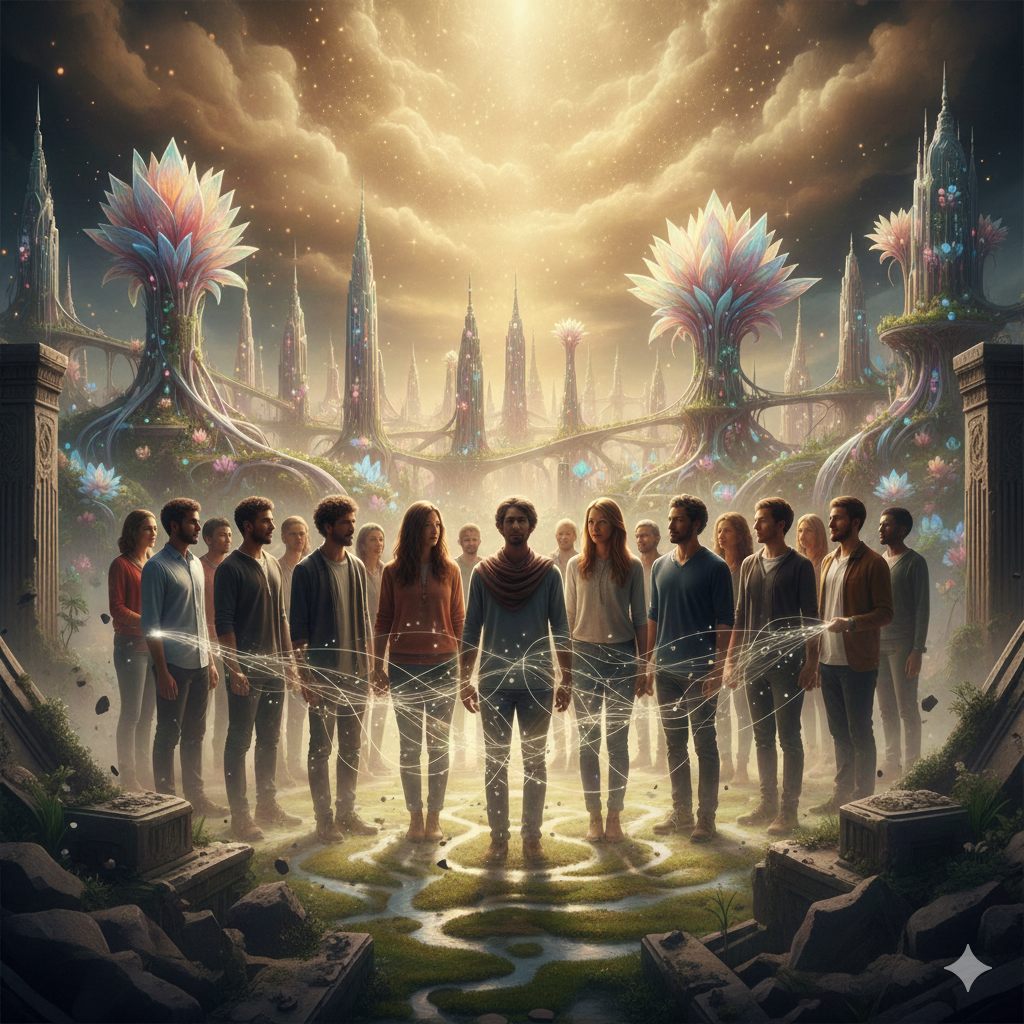
Communities could become something we don’t have language for yet. Not congregations learning from authorities. Not groups seeking what they lack. But gatherings of divine beings recognizing each other, building solutions from collective sacredness rather than hierarchical expertise.
I don’t know what that looks like practically. I don’t have the blueprint.
But I’m starting to think the refusal isn’t just theological. It’s the thing that holds the current order together. The gap between human and divine, the distance that must be crossed, the worthiness that must be earned—that gap is load-bearing for almost every structure we’ve built.
Close the gap, and what happens?
What becomes possible when there’s nothing left to achieve, no transcendence to aspire toward, no one positioned above anyone else by virtue of their proximity to the sacred?
What does collective divinity build?
I don’t think wisdom traditions are wrong about the experience they describe. I think they’re accurate about the nearness, the unity, the dissolution of separation.
I think they refuse to state it plainly because stating it plainly changes everything.
And maybe we refuse it too—not just in our traditions but in our structures, our systems, our treatment of each other—for the same reason.
Because if humans are divine, actually divine, all of us right now as we are, then most of what we’ve accepted as inevitable becomes intolerable.
That’s not mysticism. That’s revolution.