
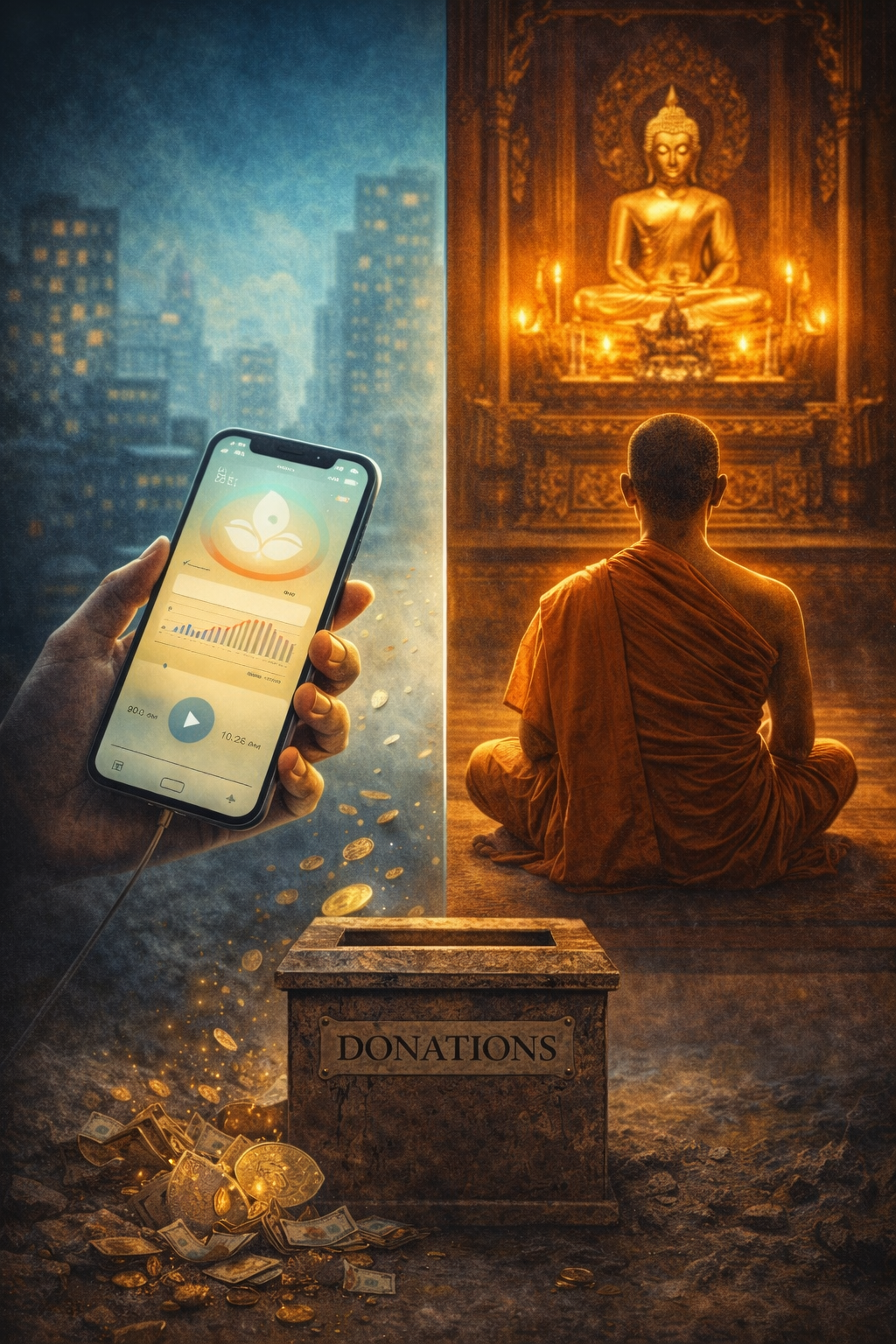
You open Headspace. Or Calm. Or Insight Timer. Choose a session: “10-Minute Stress Relief” or “Better Sleep” or “Focus for Work.” A soothing voice guides you to notice your breath, scan your body, let thoughts drift by like clouds. You do this most mornings now. Seven minutes, maybe ten. You feel calmer. More present. Less reactive when your coworker sends that passive-aggressive email.
This is meditation. Western-style. Buddhism adapted for busy professionals who need to reduce cortisol levels and improve productivity.
Except Buddhism wasn’t designed to make you better at your job. It was designed to liberate you from the entire cycle of existence.
What We Extracted
The Buddha taught the Four Noble Truths:
- Life is suffering (dukkha)
- Suffering arises from craving and attachment
- Suffering can cease
- The path to the cessation of suffering is the Noble Eightfold Path
Notice what comes third: suffering can cease. Not “be managed.” Not “be reduced through mindfulness practice.” Cease. Completely. Through enlightenment—the total extinguishing of craving, the end of the cycle of rebirth, the realization of nirvana.
The meditation you downloaded was never meant to help you tolerate your life. It was meant to help you escape all lives. Forever.
But “Download Calm: Your 8-Week Path to Escaping the Wheel of Samsara” doesn’t sell subscriptions. “Reduce stress” does. “Sleep better” does. “10 minutes to a calmer you” definitely does.
So we took the technique—mindfulness, breath awareness, body scanning—and stripped the liberation theology. We kept the part that makes us function better. We discarded the part that would require us to renounce functioning altogether.
The Gap Between App and Monastery
Buddhist monks don’t meditate for ten minutes before their commute. They meditate for hours. Daily. For decades. They take vows of celibacy, poverty, non-violence. They shave their heads. They beg for food. They own three robes and a bowl. They renounce family, career, possessions, pleasure, comfort, status, identity.
This isn’t extreme asceticism. This is what the Buddha taught. The monasteries aren’t the fringe—they’re the core. The serious practitioners aren’t the exceptions—they’re the standard.
Your meditation app offers “21 Days to Mindfulness.” Monasteries offer lifetimes. Multiple lifetimes, if you believe the cosmology. The gap isn’t about commitment level. It’s about completely different goals.
The monk meditates to see through the illusion of self. You meditate to have a better self. The monk meditates to extinguish desire. You meditate to function more effectively while pursuing your desires. The monk meditates to prepare for the dissolution of everything they think they are. You meditate to be more productive at work.
These aren’t variations on a theme. These are opposite directions.
What Buddhism Actually Requires
The Noble Eightfold Path includes: right view, right intention, right speech, right action, right livelihood, right effort, right mindfulness, right concentration.
Right livelihood means not causing harm through your work. Not weapons, not intoxicants, not exploitation. How many meditation app users work in industries that violate right livelihood? How many of us would be willing to quit?
Right speech means no lying, no harsh words, no gossip, no idle chatter. The apps teach mindful communication. They don’t teach silence.
Right view means understanding the Four Noble Truths. Understanding that attachment causes suffering. Understanding that the self is an illusion. Your app taught you to “observe thoughts without judgment.” Did it teach you that the “you” doing the observing doesn’t actually exist?
The monasteries know what Buddhism requires. Renunciation. Discipline. Discomfort. Recognition that everything you’re attached to—including your identity—has to go.
We know this too. We just don’t want it.
The Commodification
The meditation app industry is worth $2.1 billion. Calm raised $218 million in venture capital. Headspace went public through a SPAC merger valued at $3 billion.
Buddhist temples in the U.S. struggle financially. Monasteries can’t pay for basic repairs. When monks visit to teach, they often stay in members’ homes because the temple can’t afford guest accommodations.
We’ll pay $70/year for an app subscription. We won’t put $20 in the donation box at the temple.
Because the app asks nothing from us except seven minutes and an email address. The temple asks us to sit with suffering, understand impermanence, consider ordination, study texts, sit through ceremonies in languages we don’t understand honoring traditions we haven’t earned.
What We Avoid
Buddhist cosmology includes realms of existence: gods, demigods, humans, animals, hungry ghosts, hell beings. Rebirth determined by karma. Lifetimes of suffering. The whole framework.
The app doesn’t mention this. Too religious. Too metaphysical. Too weird for the secular workplace wellness program that’s paying for employee subscriptions.
We also avoid the actual Buddhists. When was the last time you went to a Buddhist temple? Met a Buddhist monk? Studied with a Buddhist teacher who actually ordained, who spent years in retreat, who knows Pali or Sanskrit, who can explain the Abhidhamma or the Visuddhimagga?
We’ll download an app narrated by a British voice actor. We’ll read books by Western converts who teach “secular mindfulness.” We’ll attend weekend retreats at yoga studios. We won’t sit in a temple, offer incense, bow to a Buddha statue, learn the chants, study the texts, support the sangha that maintains the tradition.
Because that feels too much like religion. And we wanted meditation, not Buddhism.
The Distance
Eight-week mindfulness programs teach stress reduction. Buddhist training takes years, decades, lifetimes. The distance isn’t about time. It’s about what we’re willing to face.
Stress reduction is possible while keeping your life intact. Liberation requires dismantling it. The app teaches you to be mindful while ambitious. Buddhism teaches you that ambition itself is the problem. The app teaches you to notice your thoughts. Buddhism teaches you there’s no “you” doing the noticing.
We want the technique without the tradition. Buddhism to make us better at being ourselves while Buddhism insists we aren’t selves at all. That’s not adaptation. That’s extraction.
If we actually honored Buddhism, we’d support monasteries, not apps. Study with monks, not download tracks. Engage with the full tradition—cosmology, ethics, metaphysics—not just the ten minutes before our meeting.
Or we’d be honest: we’re not practicing Buddhism. We’re using a technique borrowed from Buddhism to be more effective at pursuing exactly what Buddhism says causes suffering.
The monasteries know the difference. So do we.
The Distance continues next week