
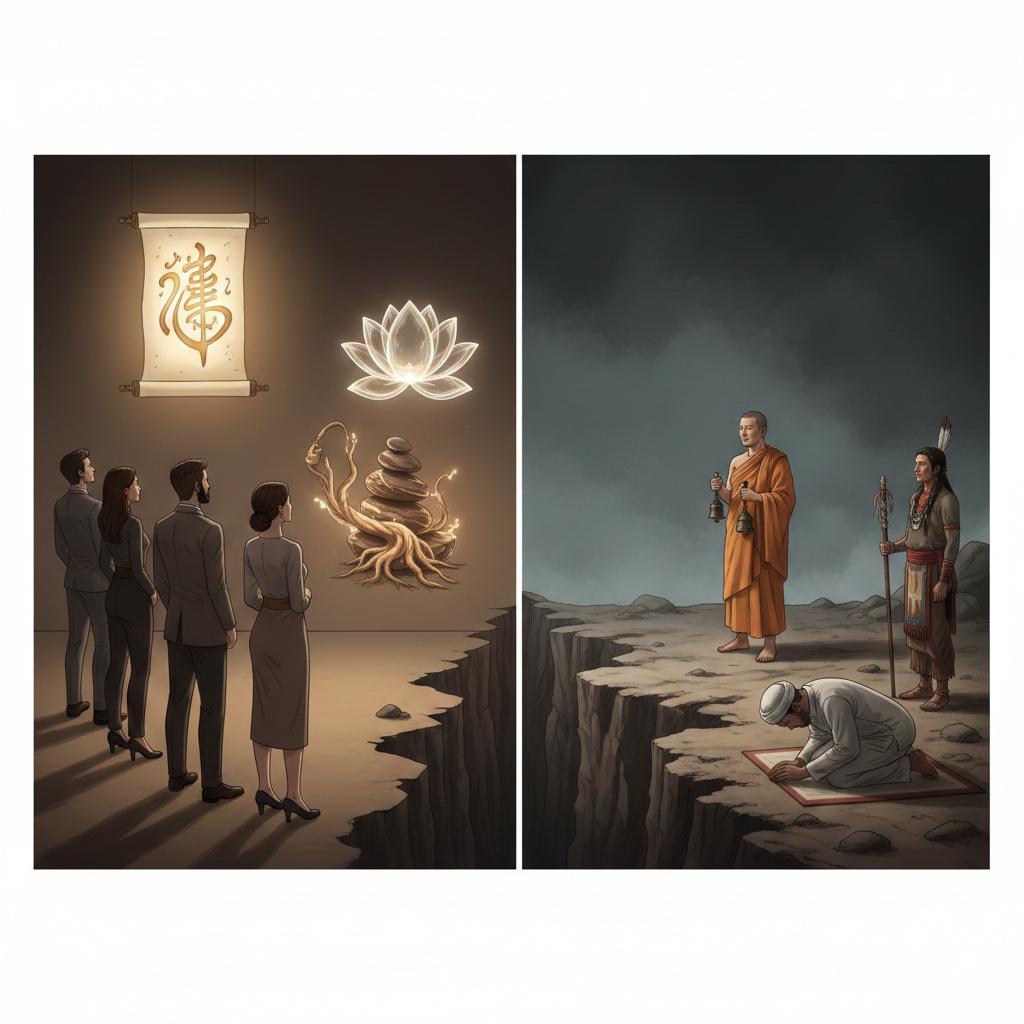
We love Rumi. Share his poetry on social media. Quote him at dinner parties. “Let yourself be silently drawn by the strange pull of what you really love.” Perfect. Universal. Safe.
Then someone mentions their Muslim neighbor and the tone shifts. “I’m sure they’re fine, but you know, that religion…”
The distance opens.
We read about Buddhism. Discuss non-attachment with genuine insight. Own three books on mindfulness. Attended a weekend retreat once. Life-changing.
Then actual Asian Buddhist practitioners show up practicing their tradition with statues and incense and chanting and we think: too superstitious, haven’t they evolved past that? Western Buddhism is so much more… refined.
The distance opens.
We celebrate Indigenous wisdom. Post quotes about seven generations and living in harmony with earth. Acknowledge we’re on stolen land. Mean it when we say it.
Then Indigenous people practicing their actual traditions appear and we think: performing for tourists, or stuck in the past, or—if they’re doing something we don’t understand—probably not the “real” tradition anyway.
The distance opens.
The pattern repeats across every tradition. The wisdom is compelling when it’s dead, translated, extracted, sanitized for our consumption. The practitioners are suspect when they’re alive, different, actually doing the thing.
The gap between knowing and being is the distance this series examines.
The Beautiful Dead Master
Rumi died in 1273. His poetry survives in translation—mostly Coleman Barks’ versions, which are lyrical and also significantly divorced from the Islamic context Rumi lived and wrote within. The Quran-saturated, Sharia-observant, prayer-practicing Sufi mystic becomes a universal spiritual figure safe for secular consumption.
This isn’t accidental. Dead masters can’t contradict our interpretations. They can’t insist on the parts of their practice we find uncomfortable. They can’t look at our lives and say “that’s not what I meant.” They’re so much easier to love than living practitioners who won’t let us extract just the parts we want.
Jalal ad-Din Muhammad Rumi was a practicing Muslim who prayed five times daily, observed Ramadan, made pilgrimage, and grounded his mystical experience in Islamic law and practice. The poems aren’t separate from that context—they’re within it.
But we extract the mystical experience, discard the practice, and call it evolution.
The same thing happens with Buddhism. The Dalai Lama writes bestsellers. Mindfulness apps proliferate. Corporate meditation spaces remove all religious imagery. Buddhism becomes a therapeutic technique—eight weeks to reduce stress, no commitment to the Eightfold Path required.
When actual Tibetan Buddhists show up with their protector deities and wrathful manifestations and elaborate rituals and reincarnation beliefs, we think: well, that’s the cultural overlay. The real Buddhism is the stripped-down version we practice. What they’re doing is just… tradition. Superstition. Not the essence.
We did this to them. Decided which parts were essential and which were cultural baggage. Took what served us and discarded the rest. Then called it respect.
The Acceptable Parts Only
Indigenous wisdom gets the same treatment. We love the seven generations principle. Post pictures of dreamcatchers. Read books about plant medicine and reciprocity and being good relatives to the earth.
Then Indigenous people say “our water is being poisoned by this pipeline” and we suddenly have questions. Are they really protecting sacred sites or is that just a political strategy? Are they living the traditional way or driving pickup trucks and using cell phones? Are they actually Indigenous enough to speak on this?
We love the wisdom when it asks nothing of us. When it’s aesthetic. When it makes us feel connected to something ancient and profound.
When it demands we actually change our relationship to land, to resources, to whose knowledge counts—when it threatens structures we benefit from—suddenly the practitioners aren’t wise anymore. They’re activists. Protesters. People with an agenda.
The distance protects us from what the wisdom actually requires.
Christian mystics get similar treatment. We read Meister Eckhart and Julian of Norwich and Teresa of Avila. Quote them freely. “God is at home. It is we who have gone out for a walk.” Profound. Striking.
Then actual practicing Christians show up and we think: how can intelligent people believe that? The mysticism was the good part. The actual practice—church attendance, prayer, sacraments, community—that’s the unfortunate residue of prescientific thinking.
We extracted what we wanted and left the rest. Called it sophistication.
When Living Practitioners Appear
Here’s what happens when practitioners show up:
The Muslim neighbor praying five times daily isn’t practicing profound Sufi mysticism—they’re being “too religious.”
The Indigenous water protector citing treaty rights and sacred obligations isn’t speaking wisdom—they’re “being political.”
We love the traditions. We just don’t trust the people.
And we don’t notice we’re doing this. We think we’re being discerning. Separating essential truth from cultural overlay. Taking what’s valuable and leaving what’s dated. Being spiritual but not religious. Honoring wisdom while rejecting fundamentalism.
The framing is always about our sophistication. Our evolution. Our ability to see the universal truth beneath the particular practice.
We never frame it as: we’re taking what serves us and discarding what challenges us. We’re loving the wisdom while maintaining contempt for the practitioners. We’re performing respect while executing dismissal.
The Performance Layer
This is how bias operates. Not through conscious malice but through automatic patterns that feel like insight.
Someone reads an anti-racism book. Feels genuinely moved. Discusses the mechanisms of oppression with real understanding. Then five minutes later makes a hiring decision based on a name that sounds “ethnic”—completely unaware they just demonstrated the exact pattern the book analyzed.
The feeling was real. The intellectual understanding was real. Neither one touched the automatic processing that drives behavior.
We do this with traditions constantly. Love the wisdom, dismiss the practitioners. Honor the teaching, reject the community. Extract the mysticism, discard the practice. And call it evolution rather than what it is: colonization at the level of ideas.
We’re not evil. We’re running code we can’t see. Code that says: wisdom is beautiful when it’s been filtered through people like us. When it’s safely historical. When it asks nothing that challenges our framework.
Living practitioners threaten that framework. They insist on parts we want to discard. They practice in ways that feel foreign or uncomfortable or too religious or too traditional. They won’t let us extract just the beautiful parts.
So we create distance. Love the teaching, question the teacher. Honor the tradition, dismiss the community. Respect the wisdom, reject the practice.
What The Distance Protects
The distance protects privilege. If Rumi is universal spiritual wisdom safely extracted from Islam, we don’t have to examine our relationship to actual Muslims. If Buddhism is really just mindfulness, we don’t have to engage the tradition’s challenges to our consumption patterns and self-focus. If Indigenous wisdom is beautiful aesthetic, we don’t have to return the land or honor treaties or change our relationship to resources.
The distance protects identity. If we’re the sophisticated ones who can see universal truth, we don’t have to submit to teachings that might require we become students instead of arbiters. We maintain the position of judgment. We get to decide what’s essential and what’s cultural overlay.
The distance protects comfort. Living practitioners are messy. They disagree with each other. They have human failings. They practice in ways that don’t fit our aesthetic preferences. They ask us to join rather than observe. They insist on commitments we don’t want to make.
Dead masters are so much easier to love.
The Gap We Can’t Close By Thinking
Understanding this pattern doesn’t fix it. That’s the frustrating part. You can read this essay, nod along, recognize yourself, feel genuinely convicted—and then tomorrow execute the exact same dismissal without catching it.
Because knowing about bias and transforming it are different operations. Every wisdom tradition teaches this: intellectual understanding is the beginning, not the end. The Buddhists call it the difference between book-learning and direct realization. Christians distinguish knowledge of doctrine from experiential faith. Sufis differentiate between knowing about God and knowing God.
You can understand non-attachment completely and still cling. You can comprehend selflessness fully and still center yourself. You can recognize your bias clearly and still execute it automatically.
The distance doesn’t close because we see it. It closes—if it closes—through sustained practice of actually being in relationship with living traditions and their living practitioners, with all the mess and discomfort that requires.
This series won’t fix that. It’s just naming what we do. Witnessing the pattern. Sitting with the gap between what we claim to honor and who we actually trust.
Next in this series: The Sufi poets we love and the Muslims we fear.