
The Gospel of Thomas opens with a promise: “Whoever finds the interpretation of these sayings will not experience death.”
Later, Jesus tells his disciples: “The kingdom is inside of you, and it is outside of you. When you come to know yourselves, then you will become known, and you will realize that it is you who are the sons of the living father.”
Not “will become” sons. Already are. Present tense.
Another saying: “There is a light within each person, and it lights up the whole universe. If it does not shine, there is darkness.”
The light’s already there. Within. Now.
If the Gnostic texts said only this—you are children of the divine, you carry the light, the kingdom is within you—they’d be stating absolute human divinity as plainly as any tradition gets.
But they don’t stop there.
The Gospel of Truth, possibly written by Valentinus himself, frames salvation differently: “Those whose name he knew in advance were called at the end, so that one who has knowledge is the one whose name the Father has uttered. For he whose name has not been spoken is ignorant.”
Wait. The Father knew certain names in advance? Called them at the end? What about everyone else?
The text continues: “Indeed, how can someone hear if their name hasn’t been called? For the one who’s ignorant until the end is a delusion of forgetfulness, and they’ll dissolve with it.”
So you have the divine light within—but maybe your name wasn’t called. Maybe you’re not one who receives knowledge. Maybe you’ll just dissolve with the delusion.
The Gospel of Mary pushes this further. Mary Magdalene has received teaching from Jesus through private revelation. She strengthens the wavering disciples and turns them toward the Good. But Peter and Andrew challenge her.
Andrew says her ideas are strange. Peter argues that Jesus wouldn’t have revealed such important teachings to a woman. That her stature cannot be greater than that of the male apostles.
Levi defends her: “Surely the Savior knows her very well. That is why he loved her more than us.”
Mary possesses knowledge superior to the public apostolic tradition. Her authority comes from private revelation. Vision. Not something everyone can access. Not something you can just recognize on your own.
You need someone who’s already received it to transmit it to you.
And then comes the full cosmological apparatus.
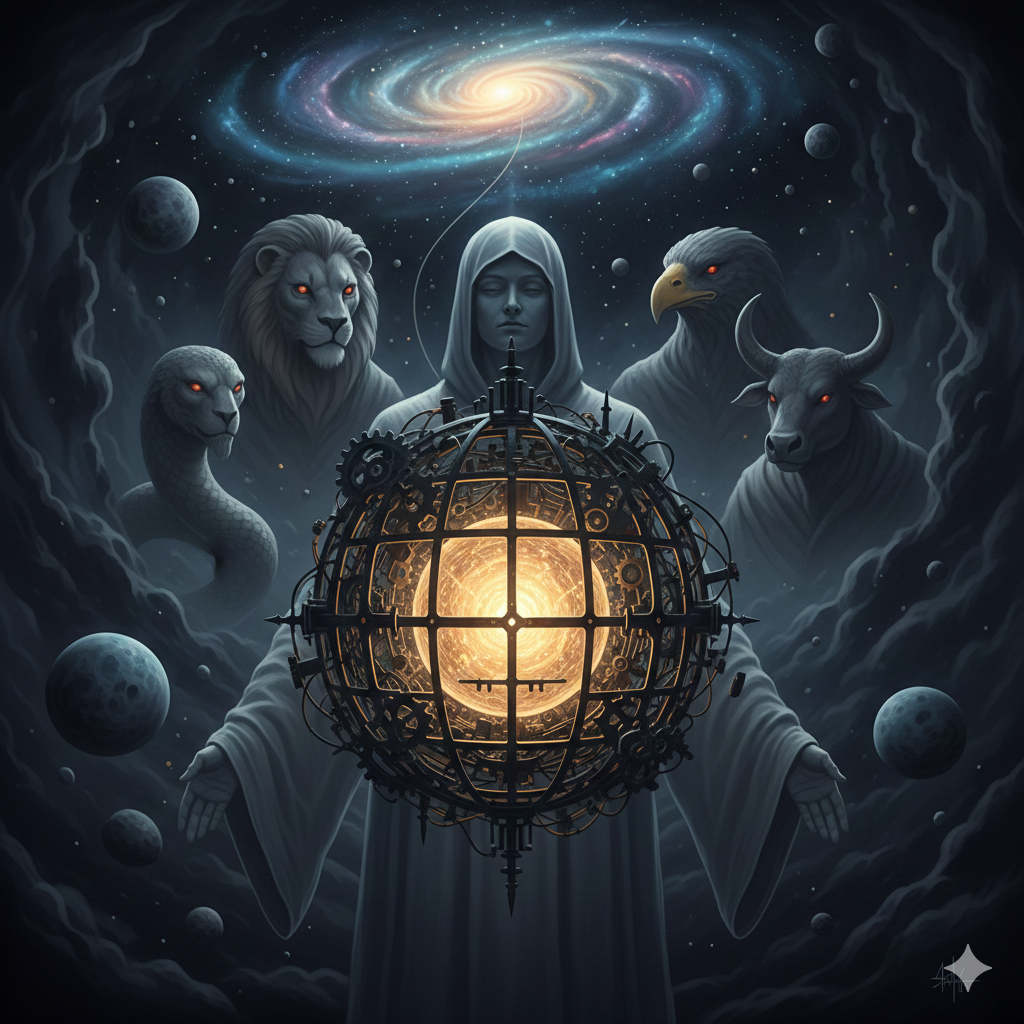
According to the Secret Book of John, here’s what actually happened: Sophia, one of the divine emanations from the Pleroma—the realm of fullness, of pure spirit—acted rashly. Without her divine consort, she tried to create something on her own. The result was monstrous. Yaldabaoth, a being with a lion’s face and a serpent’s body, ignorant and arrogant.
Horrified, Sophia cast him out into the darkness below the Pleroma.
Yaldabaoth, alone in the void, looked around and declared: “I am God, and there is no other God beside me.”
He had no idea the Pleroma existed above him. No knowledge of the true God. Just his own bloated self-certainty.
So he got to work creating. First, he generated the Archons—cosmic administrators, rulers of the planetary spheres, each with the face of a beast. Together, they fashioned the material universe. The physical cosmos you’re standing in right now.
Then Yaldabaoth saw something—a reflection from the Pleroma of the true divine Human. Inspired, he and the Archons decided to make humans in that image. They shaped Adam from matter, but the body lay lifeless. They couldn’t animate it.
Sophia, watching from above, tricked Yaldabaoth into breathing his own power—the divine power he’d inherited from her—into Adam. The body came alive.
And here’s where it gets interesting: that breath, that power, is your divine spark. The pneuma. A fragment of the Pleroma trapped inside a material body, within a material world, under the watch of cosmic jailers who have no idea what you really are.
The spark within you is literally from the realm of God.
But you’re imprisoned. The Archons built this cosmos as a trap, and they maintain it to keep you here. They create the distractions—lust, greed, anger, fear—that keep you feeding them energy and forgetting what you are. They bind you to fate, to the stars, to material concerns. They spread ignorance through false religions that point you toward worshipping them instead of recognizing your own divinity.
You can’t just be the spark. You have to liberate it.
And liberation requires gnosis—knowledge revealed only to those ready to receive it.
Not everyone has the spark, some texts suggest. The Reality of the Rulers describes different types of humans. Some people are hylics—purely material beings, capable only of physical existence. Others are psychics—stuck in the realm of soul and emotion, following the Law but unable to transcend it. Only the pneumatics—those with the divine spark—can receive gnosis and escape.
Even among the pneumatics, you need the right teaching. A revealer from the Pleroma—Christ, in many Gnostic systems—who brings knowledge of your true origin. Passwords to get past the Archons when you die. Hidden wisdom that can’t be accessed through ordinary means.
The texts themselves are described as containing “hidden words” known only to those initiated. Thomas records what “the living Jesus spoke” for those who can interpret the sayings. Not everyone. Just those capable of understanding.
The Gospel of Mary shows this hierarchy in action. Mary has the revelation. The male disciples don’t. Peter challenges her authority precisely because the knowledge isn’t democratically available—it came through private revelation to someone he doesn’t think should have it.
If everyone could just recognize their own divine spark without mediation, why would Peter’s objection matter? Why would Mary need to defend her authority? Why would Levi need to point out that the Savior loved her more, as if proximity to Jesus validates knowledge?
The texts themselves demand interpretation.
The Gospel of Truth makes this explicit: salvation comes to those whose names the Father called beforehand. Those who receive the Word. Those who are transformed from ignorance to knowledge. But those whose names haven’t been spoken? They’re “a delusion of forgetfulness” that will simply dissolve.
The cosmology—Archons, Demiurge, the material prison—creates the need for liberation through initiation into mysteries that can’t be accessed directly. Must be transmitted through proper channels by those who already possess it.
The Gospel of Thomas says the kingdom is within you. But finding the interpretation of these sayings is what saves you. Not just being the kingdom. Knowing you’re the kingdom, in the specific way this tradition teaches it.
You are divine—but cosmic circumstances have obscured that truth.
What does the refusal protect here?
The special status of the Gnostics themselves. They’re the ones with the spark who’ve awakened to it. They possess the gnosis that saves. They know the cosmic truth the Archons don’t want you to know. They’ve received private revelation that the ordinary apostolic tradition doesn’t have access to.
If you just said “you’re divine, period, full stop”—no prison, no Archons, no predetermined calling—what distinguishes the Gnostic community from anyone else?
The refusal here is particularly elaborate. An entire mythological apparatus explaining why recognizing your divinity requires initiation into a specific tradition’s cosmology and soteriology, plus a theological framework suggesting only certain people were called to receive this knowledge.
You are the light. But the universe is constructed to prevent you from shining, and only those with the spark—who’ve been called, who’ve received private revelation—can access the knowledge needed to dismantle that construction.
It’s the most explicitly dualist version of the refusal—divinity versus matter, Pleroma versus prison, pneumatics versus hylics, those called versus those not called.
Yes, you’re divine. But here’s why you can’t just be divine without us.
The spark is real. The prison might not be.