
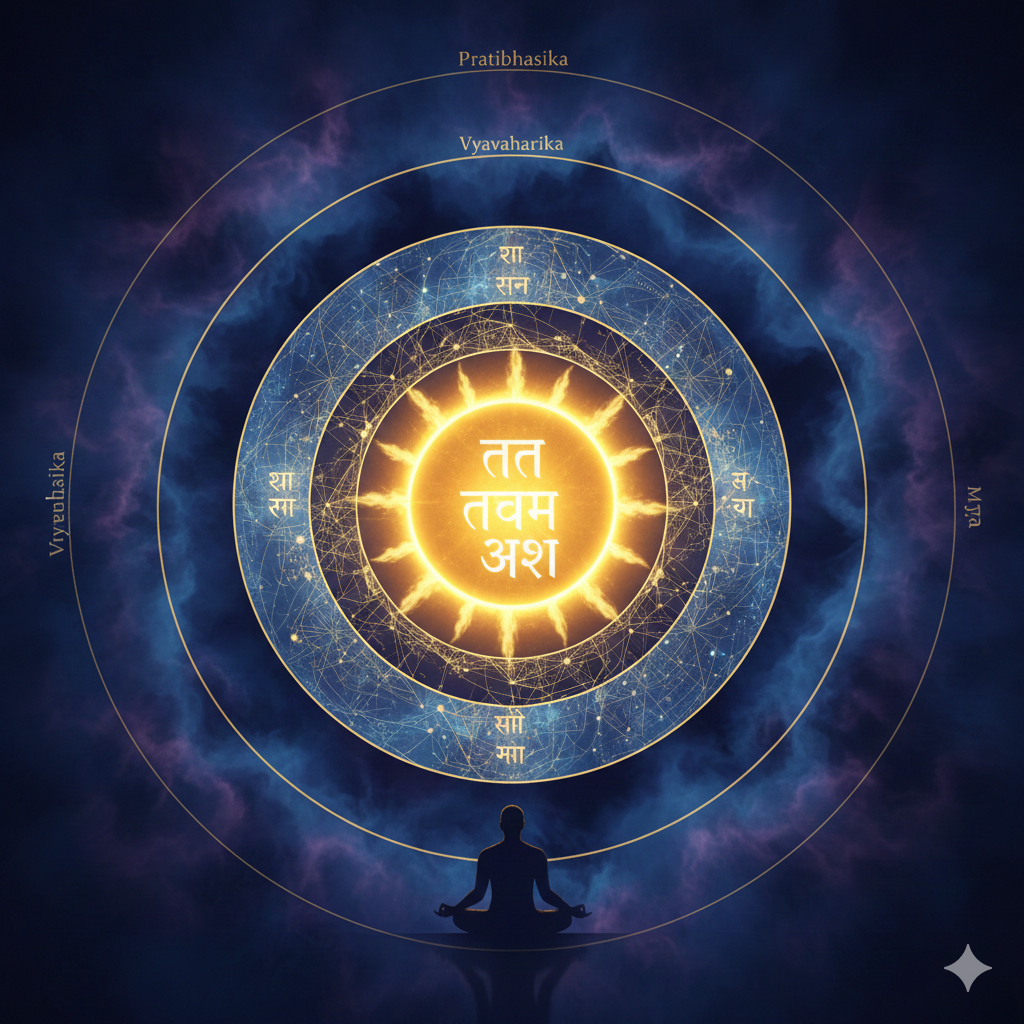
The Chandogya Upanishad tells the story of a father teaching his son. The father, Uddalaka, instructs Shvetaketu about the nature of ultimate reality through a series of examples—banyan seeds, salt dissolved in water, the subtle essence pervading everything.
After each explanation, the father repeats the same phrase: Tat tvam asi. That thou art.
Not “that you will become” or “that you can achieve through practice.” Present tense. Direct identity. You—right now, as you sit here—ARE That. Atman is Brahman. The individual self is the ultimate reality. No separation. No gap.
It’s one of the clearest statements of absolute human divinity in any wisdom tradition. The Self you are is the Self that is everything. No qualifications. No becoming. Just recognition of what already is.
And then Shankara arrives, eight centuries later, and introduces complications.
He doesn’t deny the statement. He affirms it completely. Yes, Atman is Brahman. Yes, you are That. But—and here’s where the refusal enters—you don’t know it yet. And not knowing it changes everything.
Because if you don’t know you’re Brahman, then you’re trapped in avidya, ignorance. You mistake yourself for the limited individual, the jiva, the self that suffers and dies and identifies with the body-mind. You’re veiled by maya, the cosmic illusion that makes the one appear as many, the infinite appear as finite.
So you need a path. Study. A competent guru. Years of systematic practice—sravana (hearing the teachings), manana (reflection), nididhyasana (meditation). You need to remove the ignorance that prevents you from knowing what the Upanishads already told you is true.
Notice what just happened. The statement “you are That” got reframed as “you are That but don’t realize it yet, so here’s the multi-stage process to achieve realization.”
The grammar shifts from are to realize. From identity to recognition. From present fact to future attainment.
Shankara introduces three levels of reality. Pratibhasika—the level of dreams and illusions. Vyavaharika—the everyday empirical world we all navigate. Paramarthika—the absolute level where only Brahman exists.
Most people live at the empirical level, mistaking it for ultimate reality. The world seems real, solid, separate. You seem like an individual distinct from everything else. That’s maya at work, veiling the truth.
Only at the paramarthika level—which requires proper teaching and realization—does the illusion dissolve and the truth become apparent: there’s only Brahman. Always has been.
So yes, you are That. But you’re functioning at the wrong level of reality to know it.
The effect of this framing: you now need the tradition to tell you which level you’re operating at, what illusion you’re trapped in, how to move from ignorance to knowledge. You need a guru who’s already realized what you haven’t. You need the path that takes you from where you are (deluded) to where you should be (realized).
The Upanishad said it directly: tat tvam asi. You are That. Full stop.
Shankara says: You are That, but you’re ignorant of it. Here’s the systematic study required. Here’s why a competent teacher is essential. Here’s the stages of knowledge you must move through. Here’s how maya veils the truth from you. Here’s the difference between your apparent self (jiva) and your true self (Atman).
Every addition is a qualification. Every qualification creates gap. Every gap requires path.
The teaching becomes: Reality has three levels, you’re stuck at level two, you need guidance to reach level three where you’ll finally realize what was supposedly always true.
If Atman is Brahman right now, why the levels? Why the path? Why the guru? If ignorance is what prevents recognition, what created the ignorance in the first place—and how can something unreal (ignorance, maya) obscure something absolutely real (Brahman)?
Advaita doesn’t have clean answers to these questions. Maya is neither real nor unreal—it’s anirvachaniya, indescribable. Ignorance is beginningless—anadi. The questions themselves arise from the level of empirical reality and dissolve at the absolute level.
Which means: stop asking questions, trust the teaching, follow the path, find a guru.
The Upanishads were used by later teachers to establish elaborate philosophical systems. But the original statement is stark. Tat tvam asi. That’s it. No levels. No stages. No need for realization of what already is.
Shankara’s genius was creating a framework that could hold the radical nondual claim while simultaneously building the structure that makes that claim inaccessible without the tradition’s help.
You are Brahman—but you’re ignorant. The Self you are is infinite—but you identify with the limited. The world is illusion—but you’re trapped in it. The truth is immediate—but you need years of study to know it.
Every statement preserves the nondual insight while introducing the dualism of knower and ignorant, realized and unrealized, guru and student.
What Advaita Vedanta protects through this refusal: the guru-student relationship that’s considered essential (even if not technically mandatory). The systematic study of texts and commentaries. The stages of practice. The distinction between those who’ve realized Atman-Brahman identity and those still operating under illusion.
If tat tvam asi means what it says—you ARE That, right now, no ignorance preventing it, no realization required—then what’s the guru teaching? What are the texts explaining? What’s the path moving you toward?
The tradition needs you to be ignorant so it can offer you knowledge. Needs you to be veiled so it can remove the veil. Needs you to be at the wrong level so it can guide you to the right one.
The Upanishadic sages said: You are That.
Shankara said: You are That, but let me explain what that means, why you don’t know it, and how to realize it through proper study under competent guidance.
One is a statement of fact. The other is a curriculum.
The refusal isn’t in denying Atman-Brahman identity. It’s in the gap between being and knowing. That gap is where the entire tradition lives. Close the gap, and there’s nothing left to teach.
So Advaita introduces maya—the inexplicable power that makes the absolute appear as the relative, the one appear as many. And avidya—the ignorance that makes you forget what you are. And three levels of reality—so the statement “you are Brahman” can be true at one level while you remain ignorant at another.
All of it brilliant. All of it necessary to preserve a teaching tradition around a truth that, stated plainly, eliminates the need for teaching.
The nondual insight remains. You are not separate from ultimate reality. The Self is not other than the Absolute. Tat tvam asi.
But accessing that truth? That requires the path. The guru. The systematic study. The removal of ignorance through knowledge.
And who decides when ignorance is removed? Who determines if you’ve truly realized? Who marks the transition from jiva to jnani?
The tradition. The lineage. The competent guru who’s already realized what you’re still working toward.
Same pattern. Different language. The statement of absolute identity preserved in words, dismantled in structure.
What Vedantins Say in Response
The practitioners of Advaita would object immediately. They’d say ignorance isn’t something imposed by the teaching—it’s the actual condition. People are trapped in maya, mistaking the rope for a snake, the illusory for the real. The three levels of reality aren’t arbitrary—they describe how consciousness functions at different stages of clarity.
And they’re right. That is the teaching. That is the experience described.
But the teaching creates what it describes. Once you’ve been told you’re operating at the wrong level of reality, you are. Once you’ve been told ignorance veils the truth, it does. Once you’ve been taught that realization requires systematic study, it will.
The framework becomes self-fulfilling.
If someone simply hears tat tvam asi and accepts it—”I am That, always have been, done”—the Vedantin would say they haven’t understood. They’ve grasped it intellectually, not experientially. They haven’t removed the deep-seated ignorance. They’re confusing conceptual knowledge with direct realization.
Notice what that move does. It invalidates any response except the one that requires the tradition. You can’t just be Brahman. You have to realize you’re Brahman through the proper means.
The orthodox would say this isn’t refusal, it’s precision. The Upanishad gives the destination—you are That. But it doesn’t give the map. That’s what the tradition provides. The systematic teaching that removes ignorance layer by layer.
Which sounds reasonable until you ask: if you’re already Brahman, what ignorance is there to remove? If Atman is Brahman structurally, what needs to be realized?
The answer is always: you don’t understand the question yet. That’s the ignorance speaking. Study more. Meditate deeper. Find a realized teacher.
The teaching positions itself as the only authority capable of determining whether you’ve understood the teaching.
Some would say the teacher isn’t mandatory—reading and reflection are most essential. Which softens the hierarchy. But even reading which texts, reflecting in what way—that’s guided by tradition, by commentary, by the systematic progression Shankara established.
And there’s the argument that gets closest to the heart of it: stating “you are Brahman” to someone unprepared causes harm. Spiritual bypassing. Grandiosity. Misunderstanding that leads away from truth rather than toward it.
If people hear “you are divine” before they’ve done the work to understand what that means, they’ll inflate the ego rather than dissolve it. They’ll claim enlightenment while still operating from ignorance. They’ll bypass the actual transformation required.
So the graduated path, the teacher, the careful progression through levels of understanding—all of that protects seekers from premature claims that prevent genuine realization.
Which is the strongest version of the refusal. Not “we’re protecting institutional authority” but “we’re protecting you from a truth you can’t handle yet.”
But that protection assumes you need protection. That the truth is dangerous. That direct statement of identity is harmful without proper preparation.
And who determines proper preparation? The tradition. The lineage. The guru.
So even the most compassionate version of the refusal—”we’re doing this for your benefit”—maintains the structure where some people know and others don’t, some are ready and others aren’t, some can handle the truth and others need careful guidance.
The Upanishad didn’t seem concerned about this. It told Shvetaketu directly: tat tvam asi. Repeatedly. No warning about misunderstanding. No concern about spiritual bypassing.
Just: You are That.
The refusal came later. With the systematizers. With those who built traditions around insights that threaten to dissolve tradition.
Advaita Vedanta isn’t wrong about the experience. The dissolution of separation. The recognition of nondual awareness. The seeing-through of the apparent world’s solidity.
But it can only teach that experience by maintaining the gap between those who’ve had it and those who haven’t. By positioning realization as something achieved rather than something recognized. By making “you are Brahman” into a truth that requires extensive preparation to understand.
The brilliance of Shankara’s system is that it holds the nondual insight without letting that insight dismantle the teaching structure. You are Brahman—but here’s why you don’t know it, what’s preventing you from knowing it, and how to systematically remove those obstacles.
Every answer creates the conditions for the tradition to continue offering answers.
The refusal isn’t in what Advaita teaches. It’s in the gap between the teaching and the truth. Between tat tvam asi as statement and tat tvam asi as curriculum.
One points. The other builds a path.
And in building the path, it makes you forget the pointing was enough.