
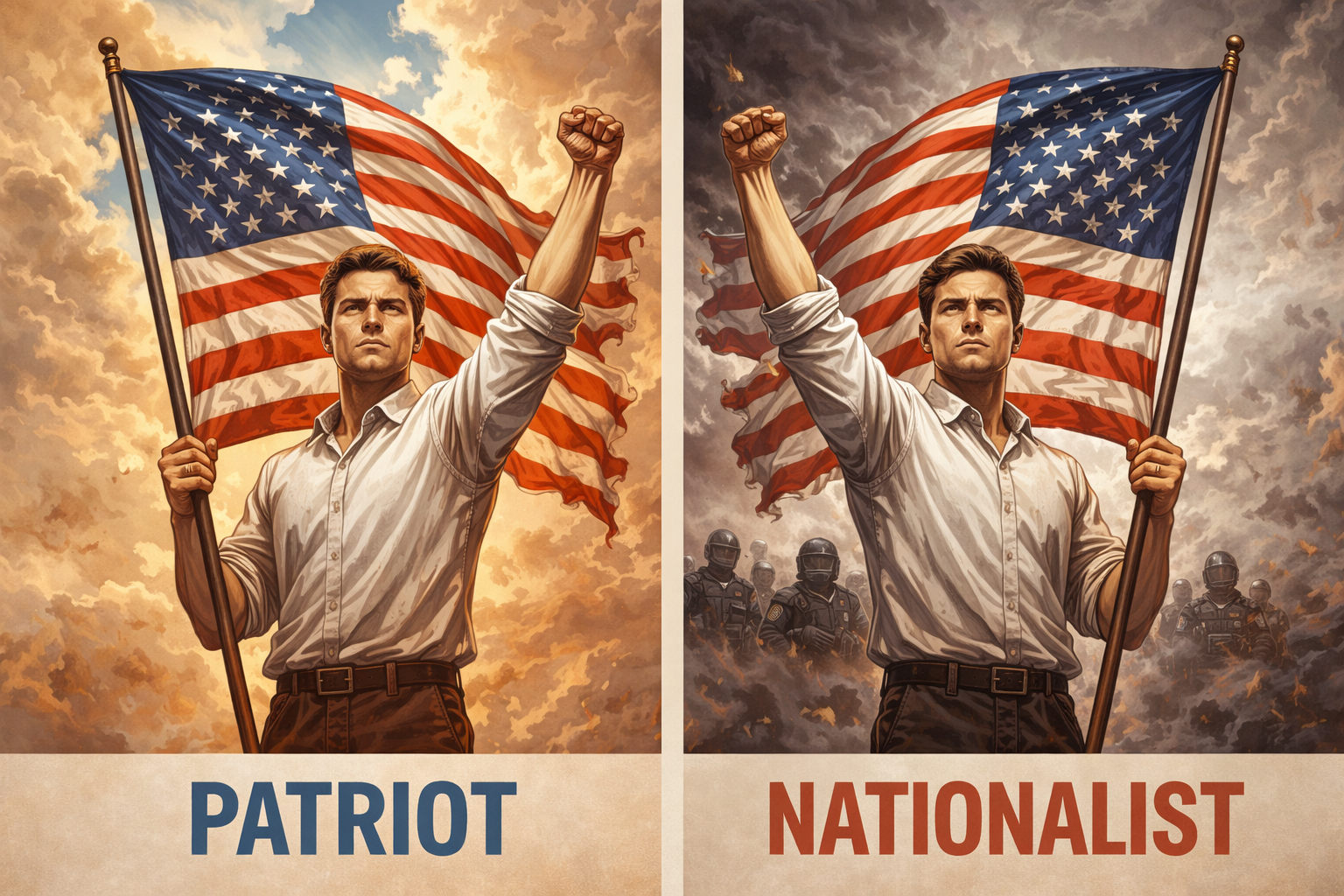
The word “nationalism” first appeared in English in 1798, combining “national” with the suffix “-ism” to mean “devotion to one’s country, national spirit or aspirations, desire for national unity, independence, or prosperity.” The concept itself emerged during the late 18th century, as the American and French Revolutions introduced the idea that nations—not empires, not dynasties, not universal Christendom—should be the organizing principle of political life.
For its first century, nationalism carried overwhelmingly positive connotations. An 1850 article in the South Australian Register captured the prevailing view: “With nationalism we see associated public spirit, independence, self-reliance, fortitude: with the latter [provincialism] there is habitually identified cringing servility, abject helplessness, domestic treachery, cowardice and bondage.” Nationalism meant wanting your people to govern themselves rather than submit to distant imperial control.
This was the nationalism of concrete liberation movements. Italians resisting Austrian occupation of their northern territories. Germans uniting dozens of fragmented states into a single nation. The Irish fighting centuries of English colonial rule. These movements shared a common conviction: that a people sharing language, culture, and historical experience had the right to political self-determination rather than foreign domination. When Giuseppe Mazzini founded Young Italy in 1831 to unify the Italian peninsula, or when Hungarian revolutionaries rose against Habsburg rule in 1848, they called themselves nationalists—and meant it as a badge of honor signifying resistance to empire.
The Academic Split: Creating Good and Bad Nationalism
The first corruption of nationalism came from mid-20th century scholars who divided the concept into two supposedly distinct types: “civic nationalism” versus “ethnic nationalism.” Civic nationalism, they argued, was based on shared political values and voluntary allegiance to constitutional principles—inclusive, rational, enlightened. Ethnic nationalism, by contrast, was based on blood, ancestry, and cultural exclusion—primitive, dangerous, prone to violence.
The distinction seemed analytical. It was actually moral gatekeeping disguised as scholarship. French civic republicanism = enlightened nationalism. German romantic nationalism = dangerous nationalism. American commitment to democratic ideals = good nationalism. Eastern European attachment to ethnic heritage = bad nationalism. The categorization allowed scholars to bless some forms of national attachment while condemning others, even when both involved the same fundamental phenomenon: people organizing political life around national rather than imperial boundaries.
The civic/ethnic distinction created a hierarchy that flattered Western liberal democracies while pathologizing other forms of national consciousness. It suggested that loving your nation for its values was sophisticated and universal, while loving your nation for its culture and history was backwards and tribal. Both are people loving their nations. One got blessed. One got condemned. Same phenomenon, moral hierarchy imposed through academic categorization.
Orwell’s Weaponization: Deliberate Redefinition
The second and more devastating corruption came from George Orwell in his 1945 essay “Notes on Nationalism,” written in the immediate aftermath of World War II. Orwell redefined nationalism as something far darker than its original meaning: “the habit of identifying oneself with a single nation or other unit, placing it beyond good and evil and recognizing no other duty than that of advancing its interests.”
This new nationalism wasn’t about self-determination or resistance to empire. It was tribalism. Power-hunger. Competitive prestige. The psychological disease of placing your group above universal human values. Orwell described it as “inseparable from the desire for power” and characterized nationalists as people whose “thoughts always turn on victories, defeats, triumphs and humiliations.”
Here’s what makes this corruption remarkable: Orwell admitted he was misusing the word even as he redefined it. “I am only using the word ‘nationalism’ for lack of a better,” he wrote. He knew he was corrupting its meaning. He did it anyway.
Why? Because he needed a word to describe the tribal fanaticism he saw in Nazi Germany, Stalinist Russia, and various other political movements. Rather than coin a new term, he hijacked “nationalism”—a word that meant wanting freedom from empire—and redefined it to mean the psychological disease of tribal supremacy.
The corruption stuck. After 1945, nationalism increasingly meant what Orwell said it meant, not what it had meant for 150 years. The word that described Irish resistance to British occupation now described the mindset that produced concentration camps.
The Patriotism Split: Same Feeling, Opposite Labels
Orwell’s essay introduced a third corruption: the false distinction between nationalism and patriotism. “Nationalism is not to be confused with patriotism,” he wrote. “By ‘patriotism’ I mean devotion to a particular place and a particular way of life, which one believes to be the best in the world but has no wish to force on other people. Patriotism is of its nature defensive, both militarily and culturally. Nationalism, on the other hand, is inseparable from the desire for power.”
This distinction seemed clean. Patriotism = loving your home without wanting to impose it on others. Nationalism = aggressive tribal supremacy seeking dominance. Patriotism = virtuous. Nationalism = dangerous.
The problem: the distinction describes the same emotion with opposite moral valences based solely on the speaker’s approval. Your nation = patriotism (we’re just defending our way of life). Their nation = nationalism (they’re aggressively asserting supremacy). The Irish wanting independence from Britain = nationalism (dangerous separatism threatening the empire). The British defending their empire = patriotism (love of country and its civilizing mission).
Watch how this works in practice. When Americans say they want to preserve their country’s character and borders, they call it patriotism. When critics describe the same people wanting the same things, they call it nationalism. Same people. Same desires. Same behaviors. The label changes based entirely on whether the speaker approves.
The patriotism/nationalism split creates moral gatekeeping that allows speakers to flatter some national attachments (“our enlightened civic values, our constitutional patriotism”) while condemning identical attachments in others (“their primitive blood-and-soil nationalism, their ethnic tribalism”). It’s a distinction that exists to distinguish “us” from “them”—to claim virtue for loving our nation while denying it to those who love theirs.
The Contemporary Result: A Word Turned Weapon
The word that described resistance to empire now describes the disease of tribal supremacy. Everyone claims patriotism. Everyone denies nationalism. Defenders call themselves patriots. Critics call them nationalists. The label changes based entirely on the speaker’s approval of whose nation is involved.
The corruption wasn’t organic. Nationalism didn’t drift into new meaning through linguistic evolution. Scholars created moral hierarchies, Orwell performed acknowledged bad-faith redefinition, the patriotism distinction weaponized the result. Three deliberate corruptions, each building on the last.
We use a distinction invented by a man who admitted it was inaccurate, wielding it as moral weapon while forgetting it was forged in bad faith. We condemn nationalism while practicing it. We claim patriotism while denying others the same attachment. The word that meant wanting freedom from distant empires became the thought-crime of loving your people.
The word still does its work. Just not the work it was created to do.