
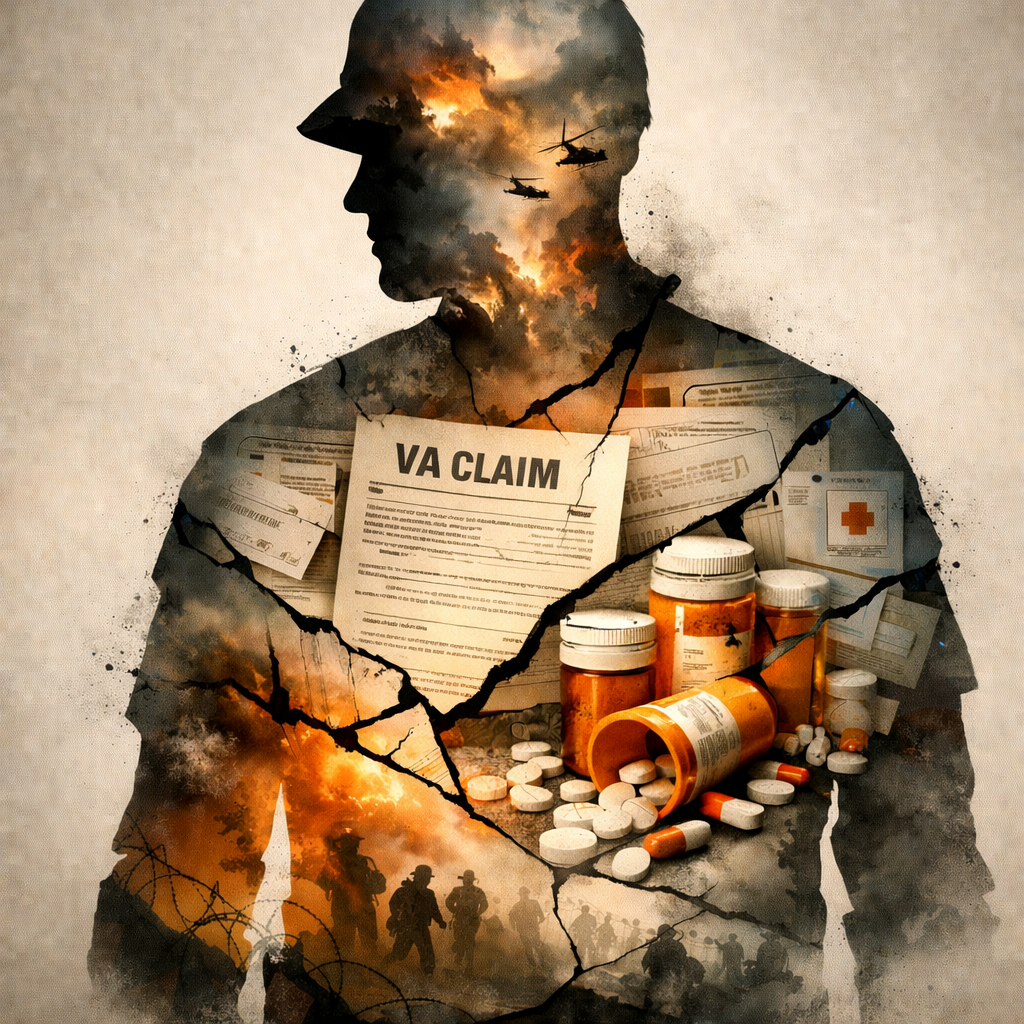
I am a veteran. I am also a former Veterans Service Officer — someone who sat across the table from other veterans and helped them navigate a system designed, at every turn, to make them prove they deserved what they were promised. I have watched people walk through that door convinced they didn’t belong there, that their injuries weren’t bad enough, that someone else deserved the help more. I know what the stigma costs. I know what the system costs. And I know what it looks like when both are being deliberately made worse.
In October 2025, the Washington Post published an investigation titled “How some veterans exploit $193 billion VA program, due to lax controls.” It led with the word “swamping.” Veterans were swamping the government with dubious claims. It highlighted conditions like hair loss, jock itch, and toenail fungus as evidence of absurdity. It gestured at brazen fraud. It implied a system out of control, a population taking advantage, a sacred commitment being exploited by the very people it was meant to serve.
What it did not tell you — and what the Post had access to — is that a significant driver of the increase in claims it was criticizing was the 2022 PACT Act, which Congress passed to expand coverage for veterans exposed to burn pits, Agent Orange, and other toxic hazards. Veterans service organizations made this point explicitly at the subsequent Senate hearing: the surge in claims wasn’t evidence of fraud. It was evidence that Congress had finally kept a promise it owed for decades. The Post framed a policy success as a systemic failure, and in doing so, handed ammunition to everyone who wanted to claw that promise back.
The VA’s own Inspector General testified before the Senate that “there is no massive fraud going on” and directly challenged the article’s framing. The Disabled American Veterans called it “a long-form editorial developed from a preconceived conclusion” supported by misleading statistics, anecdotal quotes inflated into generalizations, and near-total misunderstanding of how the VA disability system actually functions. The fraud rate in VA disability claims runs at less than one one-hundredth of one percent — fewer than 200 convictions annually against nearly 3 million claims processed.
The Post’s reporting on individual fraud cases was not wrong. The choice of what story to tell with those cases was.
As someone who has worked claims from the inside, I can tell you that the conditions the Post mocked are not what they sound like in a headline. A hemorrhoid claim isn’t vanity — it may be unexplained rectal bleeding that disrupts every day of a veteran’s life. Acne isn’t cosmetic — it may be service-connected skin eruptions that scar and burn. And a concussion isn’t a bump on the head. Mild TBI from blast exposure — the signature wound of Iraq and Afghanistan — presents as “minor” in the field. It shows up years later as cognitive decline, chronic pain, depression, and early dementia. It is exactly the kind of condition a headline writer will mock. It is exactly the kind of condition that will end a life quietly, years after anyone is paying attention.
The system doesn’t hand out ratings for inconveniences. Veterans spend months, sometimes years, documenting and re-documenting and appealing, proving their bodies were broken in the specific way the bureaucracy requires. The stigma around filing is already so severe that many never come forward at all. An article like the Post‘s doesn’t just misinform the public. It hands that stigma a megaphone, and people die in the silence that follows.
Now let’s talk about who owns the megaphone.
Jeff Bezos purchased the Washington Post in 2013. For years, the paper thrived — aggressive, well-resourced, unapologetic. “Democracy Dies in Darkness” wasn’t just a slogan; for a while, it described actual editorial choices. Then Donald Trump returned to power, and Bezos made a different set of choices.
He killed the paper’s planned endorsement of Kamala Harris eleven days before the 2024 election. He restructured the opinion section in early 2025 to focus exclusively on “personal liberties and free markets” — a phrase that means something specific in the current political context, and it isn’t neutrality. Amazon donated $1 million to Trump’s inaugural committee. Bezos stood on the dais at the inauguration alongside Musk, Zuckerberg, and Pichai. Two days before the Post announced it was cutting a third of its newsroom — 300 journalists gone — Bezos hosted Defense Secretary Pete Hegseth at his Blue Origin spaceport in Florida.
These aren’t contested claims. They were reported by NPR and documented by former Post executive editor Marty Baron in a televised interview — a man with no financial stake in the administration’s goodwill and every reason to be careful about what he said publicly. His summary was plain: “I explain it by saying the words ‘Donald Trump.’ That’s what happened.” Bezos believed the administration would target him and his other businesses if the paper continued its aggressive coverage. And so he sued for peace. The price of that peace is paid by other people.
When a billionaire who is actively courting a presidential administration also owns one of the most influential newspapers in the country, editorial independence doesn’t disappear — it gets redirected. The question is no longer whether a story is true. The question becomes what story gets told, and when, and to whom, and in service of which conclusions. The Washington Post‘s veterans piece ran in October 2025. By February 2026, we had a clear answer.
On February 17, 2026 — less than four months after the Post framed disabled veterans as a population of fraudsters — the VA published an interim final rule in the Federal Register with no advance public comment period, effective the same day it appeared. The rule, titled “Evaluative Rating: Impact of Medication,” quietly rewrote how disability ratings are calculated. Under the new standard, if medication or treatment reduces a veteran’s visible symptoms, the VA rates the disability at that lower, medicated level — not at the severity of the underlying condition without treatment.
In plain terms: follow your doctor’s orders, get your symptoms under control, and watch your rating drop.
Senator Richard Blumenthal called it “ripped straight out of Project 2025” — the Heritage Foundation’s pre-written policy blueprint, which explicitly called for “significant cost savings from revising disability rating awards.” A Navy veteran who previously worked at the VA told Task & Purpose the rule “reinforces” Project 2025 proposals to de-rate veterans entirely — to strip their ratings outright. This was not a bureaucratic miscalculation. It was a page from a document that had been written, published, and waiting.
The rule contradicted more than a decade of court decisions protecting veterans from exactly this kind of assessment. The VA called those rulings an “erroneous interpretation” and overrode them unilaterally. The rule applied broadly — to cardiovascular conditions, mental health, musculoskeletal injuries, digestive conditions — touching more than 6 million veterans currently receiving disability compensation, most of whom take at least one medication. DAV called it “alarming.” Senator Tammy Duckworth called it “shameful.” The VFW, DAV, and American Legion all pushed back hard, and within two days VA Secretary Doug Collins announced the rule would not be enforced — calling the criticism “fake news” on his way to backing down.
The rule was halted. But it was written, signed, published, and activated. Someone thought it was worth trying. And the cultural groundwork for trying it — the public narrative that veterans game the system, that their conditions are minor, that the program is bloated and ripe for cuts — had been laid four months earlier, in a major national newspaper whose owner had a great deal to gain from staying in the administration’s good graces.
There is one more detail worth noting. The VA Office of Inspector General — the office that actually investigates disability fraud — was targeted by the Trump administration for a 15 percent staff reduction. The same administration amplifying fears about fraud was simultaneously cutting the agency responsible for policing it. If fraud were genuinely the concern, that would be the last office you’d gut.
While all of this was unfolding, the administration was simultaneously dismantling the infrastructure veterans depend on to access care and file claims at all.
In 2025, the Trump administration cut nearly 28,000 VA employees — the largest single-year staffing decline in the agency’s history. Among those lost: over 2,700 nurses, more than 1,000 physicians, more than 1,000 psychologists and social workers, and over 1,800 claims processors. The employees who left had an average of nearly eleven years of experience — 577,000 years of institutional knowledge, gone in twelve months. DOGE used a flawed AI model to cancel approximately 2,000 VA contracts and let another 14,000 expire without renewal plans. The VA falsely claimed to have saved $120.8 billion through those cancellations — a figure that exceeded the entirety of VA contract spending for the entire previous fiscal year.
Mental health wait times are climbing. Clinics are canceling appointments because entire care teams have walked out and cannot be replaced. The PACT Act claims — the ones the Post piece implicitly accused of inflating the rolls — are stalling because there aren’t enough people left to process them. The same law the administration allowed the Post to misrepresent as a fraud vector is now being quietly strangled by the staffing cuts the Post piece helped justify.
All of this was already in motion when Operation Epic Fury launched on February 28, 2026.
As of March 3rd, the official U.S. count is six service members killed and 18 seriously wounded — all from the 103rd Sustainment Command, an Army Reserve unit out of Des Moines, Iowa. Not special operations. Not career soldiers at the tip of the spear. Reserve component troops. Both Trump and Hegseth have stated publicly that more deaths are expected. Secretary of State Rubio told reporters “the hardest hits are yet to come.”
But those official figures deserve scrutiny. CENTCOM’s own early statements noted additional personnel sustained “minor shrapnel injuries and concussions” and were being returned to duty — a separate, uncounted category. The scope of the theater makes the official numbers look like a floor, not a ceiling. Iran has launched strikes on at least 27 U.S. bases across the region. Between 40,000 and 50,000 U.S. troops are currently deployed across at least 19 locations spanning Bahrain, Kuwait, Qatar, the UAE, Iraq, Jordan, and Saudi Arabia. The 18 “seriously wounded” figure accounts for one confirmed strike site. It does not account for nine days of ongoing attacks across a theater that wide. International outlets tracking the conflict — Al Jazeera’s live casualty tracker was still showing the same CENTCOM figures from March 2nd as of this writing, with no updated U.S. military release — are noting the breadth of what’s happening while U.S. official numbers stay static. Al Jazeera is Qatari state-funded and carries its own editorial perspective on U.S. and Israeli military operations; it is cited here because it is one of the few outlets maintaining a comprehensive theater-wide casualty tracker that CENTCOM itself has not provided.
On March 2nd, a Kuwaiti F/A-18 shot down three American F-15Es in a friendly fire incident. All six crew members survived — but it happened, in a theater where Gulf states were never fully on board, where the coalition is improvised, and where the administration went to war without congressional authorization and without a public accounting of what comes next. These are the conditions under which people get hurt in ways that don’t show up in the initial press release.
The people in that theater right now are being exposed to exactly the conditions that generate the claims the Washington Post spent months teaching the public to distrust. Blast exposure. Burn pit emissions — documented to cause pulmonary fibrosis, airway damage, and lasting respiratory injury, the very hazards the PACT Act was written to address. Shrapnel wounds. Concussive TBI that reads as “minor” in the field and resurfaces as something else entirely five, ten, fifteen years later.
The soldiers being handed Motrin and sent back to their posts with concussions right now are the future VA claims nobody is counting yet. They will file. Some of them will file years from now, when the headaches don’t stop and the words stop coming easily and the sleep stops working. And when they do, they will be filing into a system the administration has already tried to rig against them — once publicly, with the Washington Post piece, and once quietly, with a rule pulled from a pre-written policy document that lasted exactly two days before the backlash got too loud to ignore.
That is not coincidence. That is infrastructure.
Manufactured consent doesn’t require a meeting. It doesn’t require anyone to pick up a phone and say we need you to run this piece now. It requires only that the people who own the platforms and the people who hold power share enough interests that the story writes itself in a useful direction. A billionaire who needs the administration’s goodwill owns a paper. The paper runs an investigation framing veterans as fraudulent. The administration cuts veteran services and guts the inspector general’s office while preparing for a war that will produce more veterans. A pre-written policy document supplies the rule change. The public, primed by the coverage, doesn’t push back as hard as it otherwise might. When the administration tries to quietly rewrite the compensation rules, the story is already four months old and the frame has already done its work.
The VA inspector general said it plainly: there is no massive fraud going on.
What there is, increasingly, is a massive and deliberate failure — pre-planned, carefully narrated, executed in sequence, happening right now, to people who were told the country would take care of them.
It won’t. Not like this. Not while the paper that’s supposed to hold power accountable is busy holding the door.
If you want to do something with this: the VA’s medication rule comment period is open through April 20, 2026 — public comments become part of the administrative record and carry legal weight in any future challenge. Submit at regulations.gov under RIN 2900-AS49. If you or someone you know needs help filing a VA disability claim, DAV service officers provide free assistance with no obligation. Find your nearest office at dav.org.
If you are a veteran in crisis or know one who is: the Veterans Crisis Line is available 24/7. Call 988 and press 1, text 838255, or chat at veteranscrisisline.net. You don’t have to be in active crisis to call — they’re there for any moment when you need to talk.
Sources
A note on sourcing: The hard news in this piece — casualty figures, VA staffing numbers, the medication rule text — is drawn primarily from military and institutional sources: Stars and Stripes, Military Times, Task & Purpose, CBS News, NPR, the Senate Veterans’ Affairs Committee, the Center on Budget and Policy Priorities, and the VA Federal Register itself. These carry varying degrees of ideological lean but are reliable on factual reporting in this domain. The DAV and AFGE are advocacy organizations with an obvious stake in veterans benefits; their data is cited because it draws directly from VA OIG and GAO records, which are nonpartisan and verifiable. The Bezos/Washington Post narrative is sourced primarily from NPR and from Marty Baron’s on-record televised comments — not from ideologically motivated outlets — specifically to ensure that the most central argument in this piece rests on the most credible available sourcing. Al Jazeera is Qatari state-funded and carries editorial perspective on U.S.-Israeli military operations; it is cited only for theater-wide casualty tracking that no U.S. outlet has compiled. Readers who want to verify any claim in this piece are encouraged to follow the links below directly to the source documents.
- DAV, “Media assaults VA disability system, insults those who use it,” March 5, 2026: dav.org
- DAV, “DAV’s response to shameful Washington Post article,” October 9, 2025: dav.org
- DAV, “DAV statement on VA Interim Final Rule concerning disability ratings and medication,” February 2026: dav.org
- Washington Post, “How some veterans exploit $193 billion VA program, due to lax controls,” October 6, 2025: washingtonpost.com
- Stars and Stripes, “Disability fraud is a ‘tiny fraction’ of VA claims, advocates say,” October 30, 2025: stripes.com
- Stars and Stripes, “Veterans slam new VA rule for determining disability ratings,” February 17, 2026: stripes.com
- Stars and Stripes, “6 US service members killed in Iranian strike in Kuwait,” March 2, 2026: stripes.com
- Military Times, “VA halts implementation of controversial disability rating rule following backlash,” February 19, 2026: militarytimes.com
- Military Times, “Six dead, 18 service members injured in Iran operation,” March 2, 2026: militarytimes.com
- Task & Purpose, “Concern and confusion erupt over new VA disability rule,” February 2026: taskandpurpose.com
- Task & Purpose, “Six US service members killed, others wounded in operations against Iran,” March 2, 2026: taskandpurpose.com
- CNN, “No warning, no siren: six US service members killed in Iranian strike in Kuwait,” March 2, 2026: cnn.com
- CBS News, “U.S. death toll in Iran war rises to 6 as Trump says campaign could last 5 weeks,” March 2, 2026: cbsnews.com
- NPR, “The Washington Post cuts a third of its staff,” February 4, 2026: npr.org
- NPR, “6 U.S. soldiers have been killed as the war with Iran further engulfs the region,” March 2, 2026: npr.org
- Senate Veterans’ Affairs Committee (Blumenthal), “Cuts, Cover-Ups, & Chaos,” January 22, 2026: veterans.senate.gov
- Center on Budget and Policy Priorities, “Veterans Have Borne Trump Administration’s Deep Cuts to Federal Personnel,” February 2026: cbpp.org
- AFGE, “New Report Details How Trump’s Policies Are Harming Veterans, VA Workers,” January 2026: afge.org
- Al Jazeera, “US-Israel attacks on Iran: Death toll and injuries live tracker,” updated March 8, 2026: aljazeera.com
- Federal Register, “Evaluative Rating: Impact of Medication,” February 17, 2026: federalregister.gov
- Heritage Foundation, Project 2025: Mandate for Leadership, 2024: project2025.org
- Particle and Fibre Toxicology, “Current understanding of the impact of United States military airborne hazards and burn pit exposures on respiratory health,” October 2024