
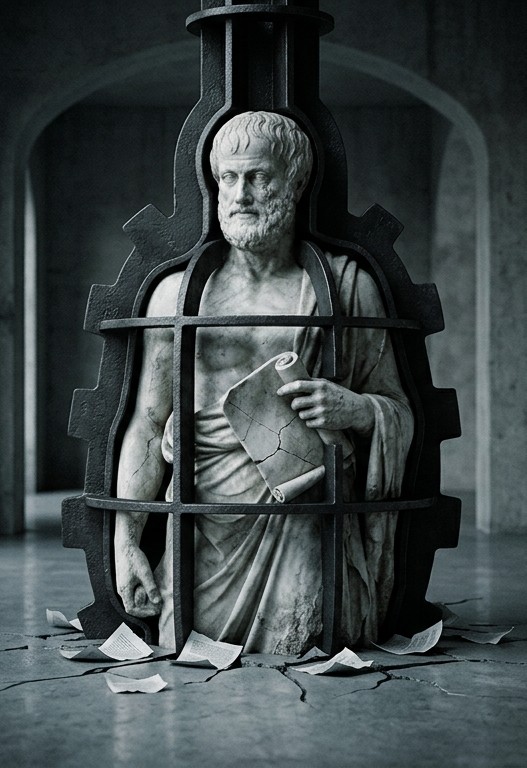
The rollback of women in combat roles. The dismantling of equity programs. The framing of a war as civilizational necessity. These are not policy disagreements. They are architectural decisions — and the blueprint is twenty-four centuries old.
That architecture is being rebuilt here now. Not metaphorically. Structurally.
The Enlightenment was always a patch. Beneath the language of universal rights and blank slates, the older architecture waited — patient, certain of its own logic. Aristotle’s hierarchy was not a social construct but a biological fact. Fixed roles, fixed natures, fixed places in an order that did not bend toward revision because it did not need to. It was simply true.
The Department of Defense is the most visible site of this reconstruction, but not the only one. Across federal agencies, the dismantling of equity programs and the reassertion of fixed biological roles share the same blueprint. In the military it is simply most legible: an exclusive class being re-established, defined by traits deemed natural to warriors. Aristotle called it arête: excellence belonging to those built for it, not manufactured in those who aren’t. The rollback of women in combat roles isn’t framed as preference. It is framed as restoration. The return of something true that was temporarily obscured.
Thomas Aquinas completed the synthesis twelve centuries later, soldering Aristotle’s secular hierarchies to divine decree. What had been biological necessity became Providential order. Fixed roles, fixed stations, fixed borders — not imposed but revealed. This is the foundation the current moment is building from. Created Order rather than self-creation. The insistence that certain truths about human beings are not subject to revision.
The rhetoric follows its own ancient logic. Aristotle named three modes of persuasion: ethos, the authority of the speaker’s character; pathos, the emotional resonance with a crowd; logos, the technical argument. The current political moment has abandoned logos almost entirely. What remains is the projection of a sovereign self — the Great-Souled Man of the Nicomachean Ethics — and the emotions that self detonates in those who recognize themselves in his dominance or fear their exclusion from it. This isn’t accidental. It is the rhetorical mode Aristotle described for a body organized around a dominant sovereign rather than deliberative process.
This logic is now being aimed outward.
The war against Iran is being framed as metaphysical necessity. The Natural Other at the gate — the Barbarian who exists outside the Polis by nature, not circumstance, and therefore outside the protections that apply within it. When hierarchy is biological, when certain peoples are defined by their essential place beyond the boundaries of civilization, negotiation becomes absurd. You don’t negotiate with the category. You exercise dominance over it, or you fail in your nature.
This is the machinery running beneath the policy announcements, the executive orders, the rhetoric of restoration and return. It is not new. It preceded the nation it is currently dismantling.
The Enlightenment argued that this oldness was not wisdom but coercion wearing the mask of nature. That human potential is plastic, not fixed. That equality is not a glitch in the system but an evolutionary pressure. Not a destination. A direction.
That argument is now the counter-argument. Which means it lost the room.
We are not living in a debate. We are living in a trajectory. A society being forced back into a mold it outgrew — or tried to. The friction is structural. The weight of it falls hardest on those the old architecture was built to hold in place. It always has.
The mechanism is visible now. But visibility has never been enough on its own. People saw this mechanism clearly in Weimar Germany. They named it, documented it, traced its logic. The architecture was legible. It didn’t hold.
What visibility does is create the conditions under which resistance becomes possible. It doesn’t generate resistance. It doesn’t guarantee it. It removes the excuse of not knowing.
The people the architecture was built to hold in place have always seen it most clearly, earliest, longest. That clarity didn’t protect them. The people most insulated from the mold’s pressure are usually the last to see it, and the first to debate whether it’s really as bad as described.
Visibility without cost to the witness is not the same thing as visibility that moves anything.
Whether that seeing carries any weight depends entirely on what the witness is willing to do with it. That is not a resolution. It is the only open question left.