
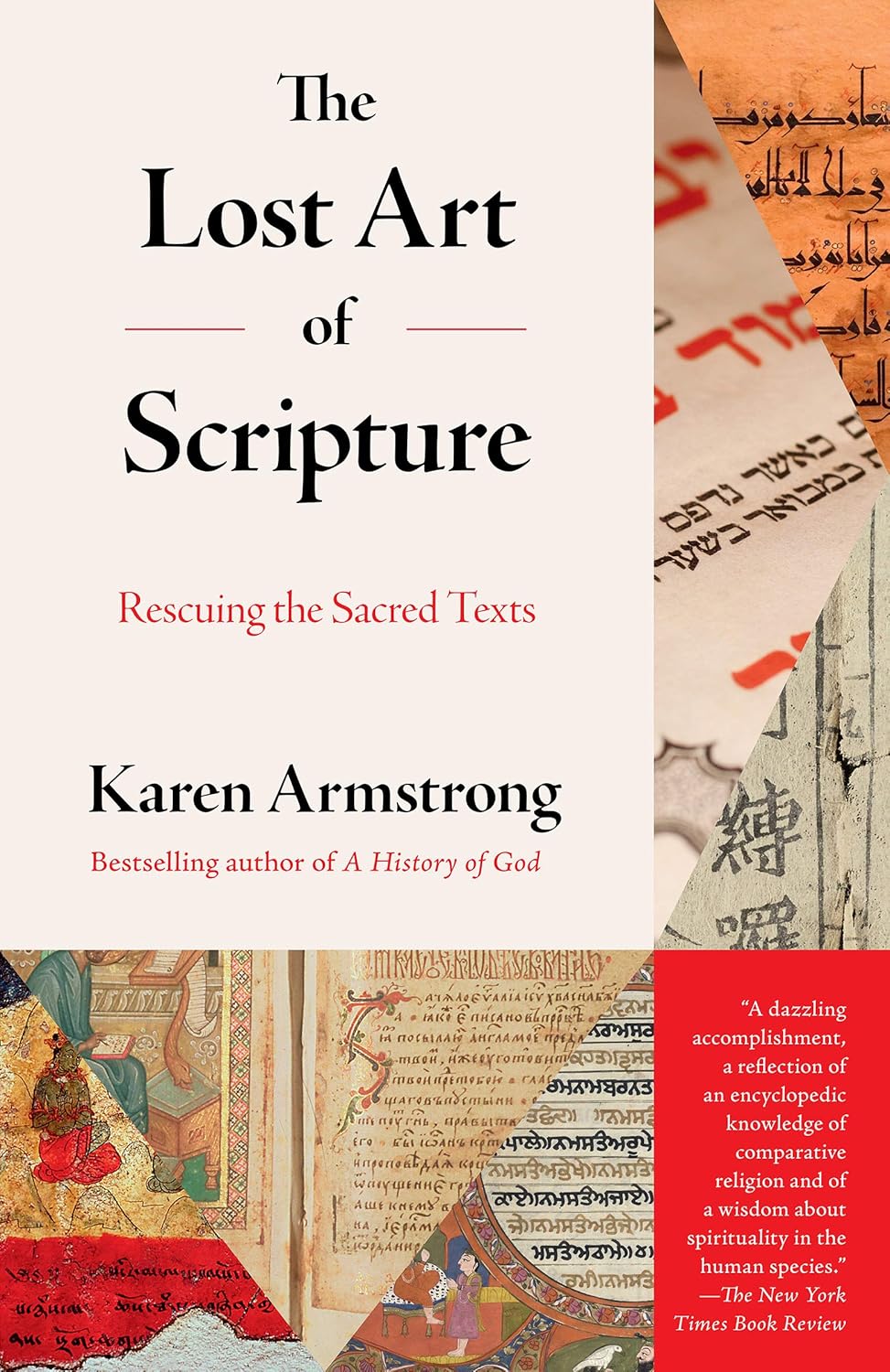
I’m only on page 72 of Karen Armstrong’s The Lost Art of Scripture: Rescuing the Sacred Texts, but three things have already rearranged how I think about what scripture is and why we can’t read it anymore.
We Turned Performance into Text
Armstrong’s central argument: scripture was never meant to be read silently, alone, in your head. It was performative art. Enacted. Embodied. Experienced in ritual, in community, with your whole body participating.
“Scripture was, therefore, essentially a performative art, and until the modern period, it was nearly always acted out in the drama of ritual and belonged to the world of myth.”
Not myth as “false story.” Myth as timeless truth that happened once but also happens all the time. The myths of scripture aren’t there to confirm your beliefs—they’re calling for radical transformation of mind and heart.
We lost this completely. We treat scripture like an instruction manual. Like a legal document. Like a set of propositions we either believe or reject. We read it alone, silently, with our analytical minds, trying to extract meaning through interpretation.
But scripture wasn’t designed for that. It was designed to be experienced—chanted, sung, enacted in ritual where your body, your breath, your senses all participate. The meaning wasn’t in the words alone. The meaning was in the doing.
When we stripped scripture of its ritual context and turned it into text to be analyzed, we lost access to what it actually is.
The Right Brain Problem
Armstrong draws on neuroscience to explain why we can’t read scripture the way it was meant to be read. The right hemisphere of the brain—holistic, metaphorical, connected—is essential to poetry, music, religion. It sees everything in relation to the whole. It perceives interconnectedness. It’s at home with metaphor, where disparate things become one.
The left hemisphere—analytical, literal, pragmatic—processes information by defining, categorizing, assessing use. It wrenches things from context. It’s competitive, overconfident, produces only reductive versions of complex reality.
Here’s the problem: Our modern approach to scripture is almost entirely left-brain. We analyze. We define. We argue about literal meanings. We categorize passages as historical or metaphorical. We assess theological positions. We debate interpretation.
But scripture was created for the right hemisphere. It requires holistic vision. Embodiment. Physical participation. The ability to see connections, not distinctions. To experience unity, not separation.
“A work of art, be it a novel, a poem or a scripture, must be read according to the laws of its genre and, like any artwork, scripture requires the disciplined cultivation of an appropriate mode of consciousness.”
We’ve lost that consciousness. Or more accurately, we’ve trained it out of ourselves. We privilege analysis over experience. Proposition over participation. Debate over embodiment.
The right hemisphere is less self-centered, more realistic, more at home with the physical and the whole. Scripture made sense there. We’re trying to process it with the left hemisphere and wondering why it feels dead.
What All Scriptures Actually Demand
Despite all their differences—despite incompatible theologies, contradictory cosmologies, irreconcilable truth claims—the scriptures agree on one thing.
You must divest yourself of egotism.
Armstrong is blunt about this: “To live in genuine relation with what Streng called the unknowable ‘ultimate,’ men and women must divest themselves of egotism.”
And the method is universal: cultivate empathy and compassion. Not just for your tribe. Not just for people who look like you or believe like you. The scriptures insist—all of them—that you cannot confine benevolence to your own people. You must honor the stranger. Even the enemy.
“It is hard to imagine an ethic that is more urgently needed in our perilously divided world.”
This is what scripture was for. Not to confirm your identity. Not to prove your group right. Not to give you divine authorization for your prejudices.
Scripture was designed to transform you away from self-centeredness toward compassion for people you’d rather not care about.
Every tradition says this in different language. Every tradition then spends centuries managing the radical implications. Every tradition builds structures that protect believers from what their own scriptures demand.
The Pattern
Seventy-two pages in, I’m seeing the pattern I’ve been tracing in the Refusal and Distance series.
Scriptures make radical demands. Traditions refuse them through interpretation, through ritual extraction, through creating hierarchies of who’s ready for which teachings. We read them wrong—analytically instead of experientially, individually instead of communally, literally instead of mythologically. We turn them into weapons for tribal identity instead of tools for ego dissolution.
And we wonder why they feel dead.
Armstrong is showing that this corruption has mechanics. Neurological mechanics. Cultural mechanics. The mechanics of turning performance into text, embodiment into analysis, transformation into confirmation.
I’m only on page 72. But I’m already convinced we’ve forgotten how to read.