
March 2, 2026
On the morning of February 28, 2026, the United States and Israel launched a coordinated military campaign against Iran. The Pentagon called it Operation Epic Fury. Israel called it Operation Roaring Lion. By the following day, Ayatollah Ali Khamenei — Iran’s Supreme Leader for nearly four decades — was dead.
Since then, the world has been moving faster than most people can track.
This piece is an attempt to lay out the full picture: what happened, what’s actually driving it, who’s doing what and why, what the risks nobody’s saying out loud really are, and what’s likely to come next. It’s long because the situation requires it. Grab coffee.
Part One: What Actually Happened
The strikes began at approximately 9:45 a.m. on February 28. U.S. B-2 stealth bombers flew from Whiteman Air Force Base in Missouri — an 11,000-mile round trip. Alongside them, the U.S. fired Tomahawk cruise missiles and deployed a new low-cost drone system modeled after Iran’s own Shahed drones. Targets included nuclear facilities, ballistic missile infrastructure, and senior leadership.
The opening strikes killed Khamenei at his office in Tehran. They also killed Iran’s defense minister, the head of the armed forces, the IRGC commander-in-chief, and top security adviser Ali Shamkhani — effectively decapitating Iran’s military and political leadership in a single operation.
Four U.S. service members have been killed — Army soldiers deployed to Kuwait in a logistics unit. The Chairman of the Joint Chiefs, General Dan Caine, told reporters: “This is not a single overnight operation.” Defense Secretary Hegseth was blunter: “War is hell.”
Iran responded by launching missile and drone barrages at Israel and at U.S. military assets across the Gulf — striking bases in Qatar, Kuwait, the UAE, Bahrain, and Saudi Arabia. Dubai and Abu Dhabi were hit for three consecutive days. The UAE alone intercepted 165 ballistic missiles, two cruise missiles, and 541 drones in just over 24 hours. An Iranian warhead landed hundreds of meters from the Temple Mount in Jerusalem. At least eight Israelis were killed.
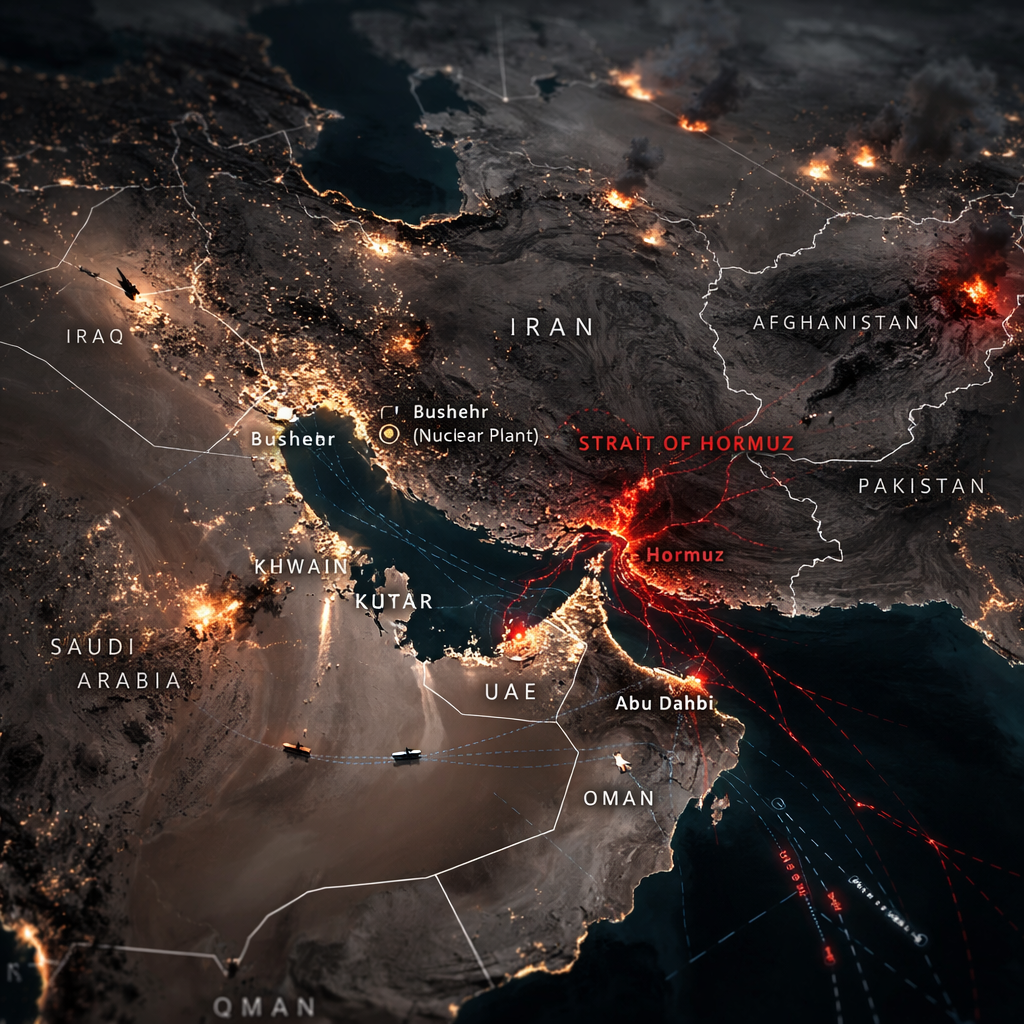
Airlines canceled over 1,500 flights to the Middle East in a single day — about 41% of scheduled arrivals. Gas prices in the United States are expected to jump more than 25 cents a gallon. Markets dropped sharply: the Dow fell over 500 points, the S&P 500 declined 1.1%, the Nasdaq 1.6%. Tanker traffic through the Strait of Hormuz has dropped approximately 70%, with over 150 ships anchored outside the strait to avoid risk.
Part Two: The Backstory Most Coverage Is Missing
Iran was already collapsing from within
You cannot understand what’s happening now without understanding what Iran looked like going in. This was not a stable adversary at the height of its power.
Between December 2025 and January 2026, Iran experienced the largest domestic uprising since the 1979 Revolution. The government’s own figures acknowledged over 3,000 civilian deaths. The Human Rights Activists News Agency documented more than 7,000. Multiple Western outlets — Time, The Guardian, Iran International — reported estimates of 30,000 to 36,500 killed in just two days in January alone. Human Rights Watch, UNICEF, and a broad coalition of UN experts condemned the crackdown. Tens of thousands remained in secret detention facilities. The regime was still executing protesters when the bombs fell.
Iran’s currency had already collapsed. Street protests were ongoing. President Pezeshkian had warned Iran’s parliament in November 2025 that harm to Khamenei could cause internal factions to turn on each other — that the regime could collapse “without need for external intervention.”
The U.S. and Israel didn’t topple a stable system. They struck a system already tipping.
A deal was apparently within reach — the day before
Here is the detail that changes the moral calculus significantly: the day before the strikes began, Oman’s Foreign Minister — who had been actively mediating nuclear talks between the U.S. and Iran — announced that a “breakthrough” had been reached. Iran had reportedly agreed to never stockpile enriched uranium and to accept full IAEA verification. A second round of talks was scheduled in Geneva.
Trump told reporters he was “not happy” with negotiations and presented a negative view of the talks, even as Iran said a deal was within reach. The strikes went forward anyway.
Israel struck first — and Netanyahu drove this
This detail matters and is not getting enough coverage: Israel pulled the trigger first. General Caine confirmed at a Pentagon briefing today: “This was a daylight strike based on a trigger event conducted by the Israeli Defense Forces, enabled by the U.S. intelligence community.” The U.S. then followed. Israel is believed to have personally killed Khamenei — Trump has been taking credit publicly, but the military record says otherwise.
The division of labor was deliberate. Israel’s operational lane was leadership decapitation: the IDF took out 40 senior Iranian commanders, eliminated the headquarters of Iran’s General Staff for Internal Security, and dismantled Iran’s air defense network in three stages — western Iran first, then air supremacy over the country, then direct strikes over Tehran. The U.S. provided the heavy capability: B-2 bombers from Missouri, naval Tomahawk salvos, cyber and space command operations. Israel kills the people. The U.S. destroys the infrastructure.
Multiple sources, including Axios, report that Netanyahu told Trump in February that it was impossible to make a good deal with Iran, and that even if a deal was made, Iran wouldn’t abide by it. Trump had been open to a deal. Netanyahu apparently changed his mind — and Trump’s. The sequencing supports this reading: diplomatic breakthrough announced, Netanyahu weighs in, strikes launched within 24 hours.
One detail that hasn’t been explained publicly: Netanyahu’s state aircraft spent over eight hours airborne before landing in Berlin rather than Cyprus. Landing in Germany would have required prior coordination. Germany is a member of the International Criminal Court, which has issued an active arrest warrant for Netanyahu. No one has publicly explained why that flight ended where it did.
Part Three: Venezuela Was Phase One
This is the thread that almost nobody in mainstream coverage has connected, but analysts are now saying it plainly.
The U.S. didn’t enter this conflict without preparation. The Venezuela operation — the removal of Maduro on January 3rd and the seizure of Iranian and Venezuelan shadow-fleet oil tankers in the months prior — was a preemptive energy hedge.
Venezuela holds the world’s largest proven oil reserves. By seizing Maduro and taking control of Venezuelan infrastructure, Trump reclaimed a vast energy asset outside OPEC’s reach and outside Tehran’s influence. VP Vance made the logic explicit: “We control the energy resources, and we tell the regime, you’re allowed to sell the oil so long as you serve America’s national interest.”
The tanker seizures served double duty: they cut Iran’s shadow fleet revenue AND disrupted their oil logistics before the strike. The ships being seized were simultaneously smuggling oil for Iran’s Revolutionary Guard and for Venezuela, using false flags.
Lay it out sequentially and the strategy becomes visible:
- December 2025: Shadow fleet tanker seizures begin, cutting Iran-Venezuela oil revenue.
- January 3, 2026: Maduro removed. U.S. takes control of world’s largest proven reserves.
- February: Nuclear talks with Iran, apparently while planning strikes simultaneously.
- February 27: Oman declares diplomatic breakthrough; deal reportedly within reach.
- February 28: Operation Epic Fury launched.
Whether you call that strategic genius or breathtaking cynicism — or both — the sequencing was deliberate. Venezuela was Phase One of an operation that culminated in Epic Fury.
Part Four: The Strait of Hormuz and Who Gets Hurt
About 20 million barrels of oil per day — roughly 20-25% of global supply — transits the Strait of Hormuz, originating from Iran, Iraq, Kuwait, Qatar, Saudi Arabia, and the UAE.
China, India, Japan, and South Korea together account for 69% of all crude oil flowing through the strait. Here’s who gets hurt hardest:
India imports roughly half its crude oil through the strait and has already activated contingency plans.
Japan and South Korea are heavily dependent with almost no alternative supply routes.
Europe loses access to Qatari LNG at a time of high seasonal demand, forcing expensive spot-market alternatives. That means household utility bills and heavy industry costs across the continent.
Global agriculture takes a hit nobody’s talking about: one-third of the world’s fertilizer trade also passes through the Strait. That disruption compounds existing damage to global food supply chains from the Ukraine war.
For context: the 1973 Arab oil embargo removed about 7% of global supply and caused a 300% price spike. A full Hormuz closure removes 20%. Standard economic models likely underestimate the nonlinear shock of that. Some analysts are projecting oil hitting $175-200 per barrel in a sustained closure scenario.
Part Five: The Nuclear Tripwire Nobody’s Saying Loudly Enough
This is the risk that deserves far more coverage than it’s getting.
Bushehr is Iran’s only commercial nuclear power plant — a Russian-designed reactor on the Gulf coast, fueled by Russian-supplied uranium, with Russian employees permanently on site. As of February 28th, Rosatom evacuated 94 family members but confirmed minimum necessary personnel remain. Russian nationals are still inside. Right now. In an active war zone.
Russia’s own nuclear energy director called it explicitly: a strike on the operating reactor “will be a catastrophe comparable to Chernobyl.”
But Chernobyl was in the middle of Ukraine — relatively contained geography. Bushehr is different. The Persian Gulf is a largely enclosed body of water with limited exchange with the Indian Ocean. Radioactive contamination could persist for years. Almost 60 million people across the Gulf rely on desalinated water. Qatar’s Prime Minister has warned that a radiological leak could leave countries like Qatar, Kuwait, and the UAE without usable water in three days. You don’t even need to hit the reactor directly — cut the power lines and the cooling systems fail. A strike on power infrastructure alone could trigger a meltdown.
Now here’s the geopolitical tripwire: if Russian nationals die at Bushehr — whether from a misdirected strike, a drone, or a power disruption causing a meltdown — Putin has a casus belli. He’s already on record having personally discussed the safety of nuclear plant personnel with both U.S. and Israeli officials. He’s drawn the line publicly. If those personnel die, he cannot back down politically without catastrophic loss of face at home.
Russia’s conventional military is hollowed out from Ukraine. Its nuclear arsenal is not.
There is a second reactor nobody’s discussing: the Barakah nuclear plant in the UAE. Iran has been striking UAE targets for three days. Barakah sits on the same enclosed Gulf waters as Bushehr. Two operational reactors. One enclosed sea. Sixty million people dependent on desalinated water from that sea.
The reason this isn’t dominating coverage is simple: acknowledging the Bushehr risk out loud forces a conversation about whether this operation was ever containable — and that conversation implicates everyone who greenlit it.
Part Six: What Iran Is Actually Doing — and Why Dubai
Iran’s retaliation strategy is not random. It is a multi-audience operation running simultaneously, and the targeting of Dubai specifically is the clearest signal of the doctrine at work.
Dubai is not primarily a military target. It’s the world’s busiest international airport, the financial clearing house for the entire region, the logistics hub connecting Asia to Europe and Africa. On day one alone, Iran fired 137 missiles and 209 drones at the UAE, with fires visible at the Palm Jumeirah and Burj Al Arab. Those are not military installations. Those are global symbols of Gulf stability and security.
Iran is running four audiences at once:
To the Gulf states: You allowed U.S. bases on your soil. Those bases were used to attack us. Host the infrastructure, share the consequences. This is the first time Iran has been in direct military confrontation with these states. That line is now permanently crossed.
To global capital: Dubai’s reputation as an “iron-clad security” haven — the reason hundreds of billions in foreign investment parked there — is being deliberately shattered. People are rushing airports and panic-buying in supermarkets in a city where residents used to leave their cars unlocked. The question isn’t just whether expats flee. It’s whether they come back.
To the U.S. domestic public: Every stranded flight, every $100-per-barrel oil headline, every market drop is pressure on Trump to define what “winning” looks like — because there is no exit ramp currently visible.
To Europe and NATO: As of today, March 2nd, Iran struck RAF Akrotiri — a British military base on Cyprus — with a drone at midnight. It is the first strike on a British military base in Cyprus since 1986. It happened hours after Prime Minister Starmer reversed his earlier refusal and agreed to let the U.S. use British bases for defensive strikes against Iranian missile sites. The conflict has now formally reached European soil. Britain’s terror threat level is under review. Up to 300,000 British nationals are currently in the Gulf region.
Is this strategy smart? In the short term, yes — Iran is inflicting maximum economic pain with minimum direct engagement of superior U.S. military force. The deeper gamble: that global economic pain creates enough international pressure to force negotiations before the U.S. achieves regime change. Whether that calculation holds depends entirely on how long Trump will absorb domestic economic costs.
Part Seven: The Gulf States — Caught Between Two Bad Options
The Gulf states’ position is genuinely complicated — and it cuts both ways.
The Arab world’s perception of Israel has fundamentally shifted. Gulf analysts note that not even Washington could force Israel to end hostilities, secure hostage releases, or avoid escalation with Iran. In June 2025, Israel launched strikes on Iranian soil just days before new U.S.-Iran nuclear talks were set to begin — despite U.S. objections. The prevailing view across the region is that Gulf states have overestimated the Iranian threat and underestimated the Israeli one. Where Israel was once seen as David facing an Arab Goliath, the roles now appear reversed — Israel is increasingly viewed as a U.S.-backed regional hegemon pursuing not just deterrence but dominance. The Abraham Accords are effectively on life support.
And yet: Iran just spent three days bombing the countries it spent a decade trying to convince it sought peaceful coexistence with. Saudi Arabia, UAE, Bahrain, Qatar, Kuwait, Oman, Jordan — all struck. All countries that had publicly declared their territories off-limits. Iran may have hoped those strikes would force Arab neighbors to demand the U.S. end the campaign. Instead, it stiffened their resolve. Saudi Crown Prince Mohammed bin Salman held emergency consultations with Gulf leaders and declared Saudi Arabia’s readiness to place “all its capabilities at their disposal.”
So Gulf states are caught between two bad options simultaneously. They won’t side openly with Iran after being bombed by Iran. They won’t side openly with Israel — the street pressure from their own populations makes that politically impossible, especially with Gaza’s wound still raw. What they’ll do is what they’ve always done: quietly cooperate with U.S. military logistics while publicly calling for de-escalation. The deeper question — whether America’s permanent entanglement with Israel’s maximalist agenda is slowly costing it the Arab world as a strategic partner — doesn’t have a comfortable answer right now.
Part Eight: Coalitions — What They Say vs. What They Actually Do
This is where the architecture of the international order under stress becomes most visible. The gap between what institutions say and what they can do is the story.
The UN: Functionally paralyzed. Secretary General Guterres condemned the attacks and called them a threat to international peace and security. Strong words. No action possible. The U.S. holds a permanent Security Council veto. Any ceasefire resolution dies there. The UN’s collective security architecture was designed for a world where the veto powers weren’t the ones doing the attacking. That’s the structural trap — and this conflict has exposed it completely.
NATO: Issued a statement saying it was “closely watching the situation” while raising missile defense vigilance. That is the diplomatic equivalent of clearing your throat. Here’s the real NATO story: the UK blocked Trump’s request to use RAF Fairford and Diego Garcia air bases for strikes on Iran. Trump retaliated by withdrawing U.S. support for the Chagos Islands deal. A NATO ally actively refused to support a U.S. military operation. Trump economically punished them for it. That is a transatlantic rupture significant enough to reshape the alliance’s future — and it’s getting almost no coverage.
Turkey: A NATO member that refused to allow use of its bases, citing İncirlik Air Base and Küreçik radar station. Turkey is simultaneously applying for BRICS membership. One foot in NATO, one foot reaching toward the alternative order. That is the single most important NATO development nobody is headlining.
BRICS: Iran hoped for collective support. It didn’t get it. BRICS is not a security alliance — it’s an economic coordination mechanism. The internal contradictions are severe: both Iran AND the UAE are BRICS members, and Iran just spent three days bombing the UAE. India explicitly refused to join any condemnation of Israeli strikes, urging “both sides to use dialogue.” Russia and China attended joint naval exercises with Iran in January 2026 — six weeks before this war — then condemned the strikes verbally while declining any military support. The gap between symbolic solidarity and actual security commitment is vast.
China: Deeply exposed economically — purchased over 80% of Iran’s exported oil in 2025. Foreign Minister Wang Yi called the attack “unacceptable.” In less than two months, Trump removed two of Beijing’s closest allies: Maduro in Venezuela and now Khamenei in Iran, striking directly at China’s oil supply. Words from Beijing. No military movement.
Russia: Called it “a deliberate, premeditated, and unprovoked act of armed aggression.” Putin personally sent condolences. Words. Russia’s military is hollowed out from Ukraine and cannot meaningfully project power. Their leverage is the Bushehr tripwire described above — and Putin knows it.
The honest coalition summary: the U.S. is fighting this war with one real partner — Israel. Every other country is somewhere on a spectrum from reluctant silence to active opposition. The coalition that fought the Gulf War, that assembled after 9/11, that maintained pressure on Iran for decades — it doesn’t exist for this operation. The international institutions designed to manage exactly this kind of crisis are either paralyzed by veto or exposed as paper tigers.
Part Nine: The War Nobody’s Covering — Pakistan and Afghanistan
This is being completely buried under the Iran coverage, and it shouldn’t be.
On February 22nd and 26th — before Operation Epic Fury even launched — Pakistan launched airstrikes on Afghanistan, targeting what it described as TTP and ISIS-K camps in Nangarhar and Paktika provinces. Then on February 27th — the day before Epic Fury — Pakistan declared “open war” after bombing Kabul, Kandahar, and Paktia. Afghanistan retaliated with large-scale offensive operations, claiming to have killed 55 Pakistani soldiers and destroyed 19 military posts.
Pakistan then launched “Operation Righteous Fury” — note the name — striking Afghan defense facilities directly. One day later, the U.S. launches “Operation Epic Fury.” Two “Fury” operations. Two simultaneous wars. Neither the world nor the media has adequately processed this.
Why it matters enormously to everything above:
Pakistan is a nuclear-armed state with a fragile civilian government, street protests against the U.S.-Israel strikes turning violent, an active war on its western border, and the entire regional order destabilizing simultaneously. Pakistan’s defense minister accused Afghanistan of having become “a colony of India” and a base for exporting terrorism. Pakistan and India are nuclear-armed adversaries with a history of war. If Pakistan believes India is using Afghan Taliban as a proxy — and says so publicly — that introduces a nuclear India-Pakistan dimension into a conflict already involving Iran, the U.S., Israel, and the Gulf.
One analyst put the Afghan Taliban’s retaliation capacity plainly: “Drones are a poor man’s air force. The Afghan Taliban have drones, they have suicide bombers, they are innovative. Any retaliation will be in Pakistan’s urban centers. This is a recipe for chaos — and chaos is what terrorist networks seek to flourish.”
Part Ten: What Comes Next for Iran
As of this writing, an Interim Leadership Council has taken power per Article 111 of Iran’s constitution: President Masoud Pezeshkian (a relative moderate), judiciary chief Gholam-Hossein Mohseni-Eje’i (a hardliner who promised “no leniency” toward protesters as recently as January), and senior Guardian Council cleric Alireza Arafi. The 88-member Assembly of Experts will eventually select a permanent successor — but with active strikes ongoing, that will take considerably longer than it did in 1989, when Khamenei was named within a single day of Khomeini’s death.
The Council on Foreign Relations assessed three trajectories: regime continuity, military takeover, or regime collapse — and warned that none envisions meaningful positive transformation within the first year.
The IRGC is the central variable. It has grown over decades into Iran’s most powerful institution — overseeing military operations, intelligence, and vast economic interests. A wartime succession increases its leverage rather than diminishing it. Whoever comes next will owe their position to the military-security establishment.
One analyst put it directly: “Killing Khamenei is not, in itself, ‘regime change.’ Think of it as changing a light bulb: to change it, you must first remove the broken bulb. But doing so is not changing the bulb. That requires replacing it with a new one.”
Iran’s opposition in exile is fragmented and lacks unified leadership. Importing a figurehead from abroad “has limited credibility on the ground and risks repeating past experiments with parachuted elites that ended badly elsewhere.” The last time the West tried that in Iran, it produced the Shah — and then the Revolution.
Trump called on Iranians to “take over your government.” There are pro-government demonstrations in Tehran alongside scenes of celebration in some areas. Populations do not respond to external calls for revolution on predetermined schedules.
The Full Picture, Stated Plainly
Step back and look at what’s simultaneously active right now on March 2nd, 2026:
- U.S.-Israel vs. Iran: active war, day 3.
- Pakistan vs. Afghanistan: active war, day 4, with nuclear India implicated.
- Strait of Hormuz: effectively closed, tanker traffic down 70%.
- Gulf states struck across 8 countries.
- Houthis resuming Red Sea attacks.
- Hezbollah firing into Israel.
- A nuclear reactor with Russian nationals inside a live war zone.
- Two nuclear powers (Russia, China) backing the attacked nation verbally while being constrained from acting.
- A U.S. president who announced a war on TruthSocial at 2am without a congressional address, with no exit strategy and no coalition beyond one ally, is now four days in with a shifting timetable — Trump has variously said two to three days, four weeks, and four to five weeks — each time insisting it could be longer or shorter.
These are not separate stories running in parallel. They are one story — a regional order coming apart across multiple fronts simultaneously, with no functioning international institution capable of containing any of it.
A study of thirty asymmetric interstate conflicts involving the U.S. from 1918 to 2003 shows that coercion most often failed when the U.S. lacked a viable ground alternative. There is no organized, militarily capable indigenous force in Iran positioned to exploit what airpower creates. There is no defined termination mechanism.
What to watch: whether the IRGC backs a hardline successor quickly and stabilizes the system in a more militarized form; whether the Khanna-Massie congressional authorization resolution gains any traction; whether the Pakistan-Afghanistan conflict pulls nuclear India further in; and whether oil prices and economic blowback build enough domestic pressure to force negotiations before the military objective of regime change is achieved.
That last question — whether economic reality breaks political will — is the actual war being fought right now. The bombs are its most visible expression. But the outcome will be decided in markets, in parliaments, in the streets of Tehran and Karachi and Dubai, and in the calculations of leaders in Beijing and Moscow who are watching very carefully to see how far one man with no congressional mandate and one allied military can actually go.
A note on sources: This piece draws on reporting from NPR, the Associated Press, CNBC, CNN, the Washington Post, Al Jazeera, Axios, The Conversation, the U.S. Energy Information Administration, the Center for Strategic and International Studies (CSIS), the Stimson Center, the Atlantic Council, Chatham House, the Middle East Institute, and Wikipedia’s aggregated conflict timelines. Source-specific bias notes are included below.
Sources
On the strikes, military operation, and casualties:
- NPR: “U.S.-Israeli Strikes in Iran Continue Into 2nd Day” — March 1, 2026. https://www.npr.org/2026/03/01/nx-s1-5731365/us-israeli-strikes-region
- NPR: “Trump Launches ‘Operation Epic Fury’ on Iran” — Feb. 28, 2026. https://www.npr.org/2026/02/28/nx-s1-5730333/the-u-s-and-israel-launch-a-major-attack-on-iran
- NPR: “World Leaders React to Operation Epic Fury” — Feb. 28, 2026. https://www.npr.org/2026/02/28/nx-s1-5730352/world-leaders-reaction-operation-epic-fury
- CBS News: U.S. casualties reporting — March 1, 2026.
- Aviation Week Network: “Israel Strikes Tehran as ‘Operation Epic Fury’ Enters Day 2” — March 1, 2026. https://aviationweek.com/defense/budget-policy-operations/israel-strikes-tehran-operation-epic-fury-us-enters-day-2
- Wikipedia: “2026 Israeli–United States Strikes on Iran.” https://en.wikipedia.org/wiki/2026_Israeli%E2%80%93United_States_strikes_on_Iran
On the diplomatic breakthrough and Netanyahu’s role:
- Security Council Report / UN documentation — Feb. 27-28, 2026.
- Axios: “4 Reasons Why the U.S. Attacked Iran With Israel” — Feb. 28, 2026. https://www.axios.com/2026/02/28/us-israel-iran-attack-reasons
On Venezuela as Phase One:
- Modern Diplomacy: “Why Maduro’s Ousting Is Phase One in Preparing for Iran.” https://moderndiplomacy.eu
- PBS NewsHour: “U.S. Aims to Assert Its Control Over Venezuelan Oil.” https://www.pbs.org
- CSIS: “Why Did the United States Seize a Venezuelan Oil Shipment?” https://www.csis.org
- The Reporter: “U.S. Moves to Legally Control Tanker and 2M Barrels of Oil Seized Off Venezuela’s Coast.” https://www.thereporter.com
On the Strait of Hormuz and economic impact:
- Al Jazeera: “What Is the Strait of Hormuz?” https://www.aljazeera.com/news/2026/2/28/us-and-israel-attack-iran-what-we-know-so-far
- U.S. Energy Information Administration: “Strait of Hormuz Remains Critical Oil Chokepoint.” https://www.eia.gov
- The Conversation: “Strait of Hormuz: If the Iran Conflict Shuts the World’s Most Important Oil Chokepoint.” https://theconversation.com
- Wikipedia: “2026 Strait of Hormuz Crisis.” https://en.wikipedia.org/wiki/2026_Strait_of_Hormuz_crisis
On the Bushehr nuclear tripwire:
- Bulletin of the Atomic Scientists: “The Radiation Risks of Iran’s Nuclear Program.” https://thebulletin.org
- CSIS: “The Fallout Factor in Targeting Iran’s Nuclear Program.” https://www.csis.org
- Anadolu Agency / AA: “Russia Says Strike on Bushehr May Lead to ‘Catastrophe Comparable to Chernobyl.'” https://www.aa.com.tr
- TRT World: “Why Is There a Scare Around Israel Hitting Iran’s Bushehr Nuclear Plant?” https://www.trtworld.com
- IntelliNews / bne: “Rosatom Confirms Bushehr Nuclear Plant Undamaged as Russia Evacuates 94 People.” https://www.intellinews.com
- Pravda (international edition): “Damage to Bushehr and Barakah Could Have Catastrophic Consequences.” https://news-pravda.com
On Iran’s retaliation strategy and Dubai:
- Fortune: “As Iran Attacks Dubai, the Tax-Free Haven Could See ‘Catastrophic’ Fallout.” https://fortune.com
- The Conversation: “Why Did Iran Bomb Dubai? A Middle East Expert Explains.” https://theconversation.com
- Al Jazeera: “More Blasts Rock Dubai, Doha and Manama.” https://www.aljazeera.com
- CSIS: “The Regional Reverberations of the U.S. and Israeli Strikes on Iran.” https://www.csis.org
- India TV News: “Why Is Iran Attacking Its Neighbours? The Strategy Explained.” https://www.indiatvnews.com
On the Gulf states’ position and Israel:
- Middle East Institute: “Gulf Arabs Fear Israel Is Becoming Goliath.” https://www.mei.edu
- Chatham House: “Why Are Middle Eastern Governments Lobbying Against a US Attack on Iran?” https://www.chathamhouse.org
- The Jewish Chronicle: “How Iran’s Missile Strikes Reunited Gulf States Against Tehran.” https://www.thejc.com
- Atlantic Council: “Experts React: How the US War With Iran Is Playing Out Around the Middle East.” https://www.atlanticcouncil.org
On international coalitions, NATO, BRICS:
- Wikipedia: “2026 Iran Conflict” / “2026 Israeli–United States Strikes on Iran.”
- Stimson Center: “Experts React: What the Epic Fury Iran Strikes Signal to the World.” https://www.stimson.org
- SAIIA: “What Happened: Israel Strikes Iran, BRICS Shows Caution.” https://saiia.org.za
- ISPI: “Strategic Caution and Multi-Alignment: BRICS and the Middle East at War.” https://www.ispionline.it
- Cointribune: “BRICS and Iran: Why No Military Support Amid Escalation?” https://www.cointribune.com
- Foreign Policy: “Turkey’s BRICS Application Reflects Balancing Act.” https://foreignpolicy.com
- Al Jazeera: “India Breaks With China, Russia on Israel-Iran War.” https://asiatimes.com
On Pakistan-Afghanistan:
- Al Jazeera: “Pakistan Bombs Kabul: Why Are Afghanistan and Pakistan Fighting?” https://www.aljazeera.com/news/2026/3/1/pakistan-bombs-kabul
- CNN: “Pakistan Declares ‘Open War’ With Afghanistan.” https://www.cnn.com
- Euronews: “Pakistan Declares ‘Open War’ With Afghanistan and Launches Strikes on Kabul.” https://www.euronews.com
- Wikipedia: “2026 Afghanistan–Pakistan War.” https://en.wikipedia.org/wiki/2026_Afghanistan%E2%80%93Pakistan_war
On Iran’s succession and future:
- CNN: “Who’s Running Iran Now?” — March 1, 2026. https://www.cnn.com/2026/03/01/middleeast/iran-new-supreme-leader-khamenei-dead-intl-latam
- CNBC: “Iran After Khamenei: What’s Next?” — March 1, 2026. https://www.cnbc.com/2026/03/01/iran-khamenei-dead-us-israel-strike-trump-netanyahu.html
- The National: “Who Could Replace Khamenei?” — March 1, 2026. https://www.thenationalnews.com/news/mena/2026/03/01/how-succession-works-in-iran-and-who-could-replace-khamenei/
- Council on Foreign Relations: Iran succession analysis.
- Chatham House: Iran succession analysis.
Source bias note: NPR and the Associated Press are the most consistently neutral sources cited. Al Jazeera has excellent regional sourcing but Qatar’s role as a diplomatic mediator shapes its framing. CNN and CNBC are reliable on facts but frame events primarily through a U.S. lens. CSIS, the Atlantic Council, and Stimson are mainstream foreign-policy establishments — credible but not neutral on questions of U.S. military action. Axios is reliable on insider sourcing. Pravda citations are used for specific factual claims about Russian government statements, not for analysis.