
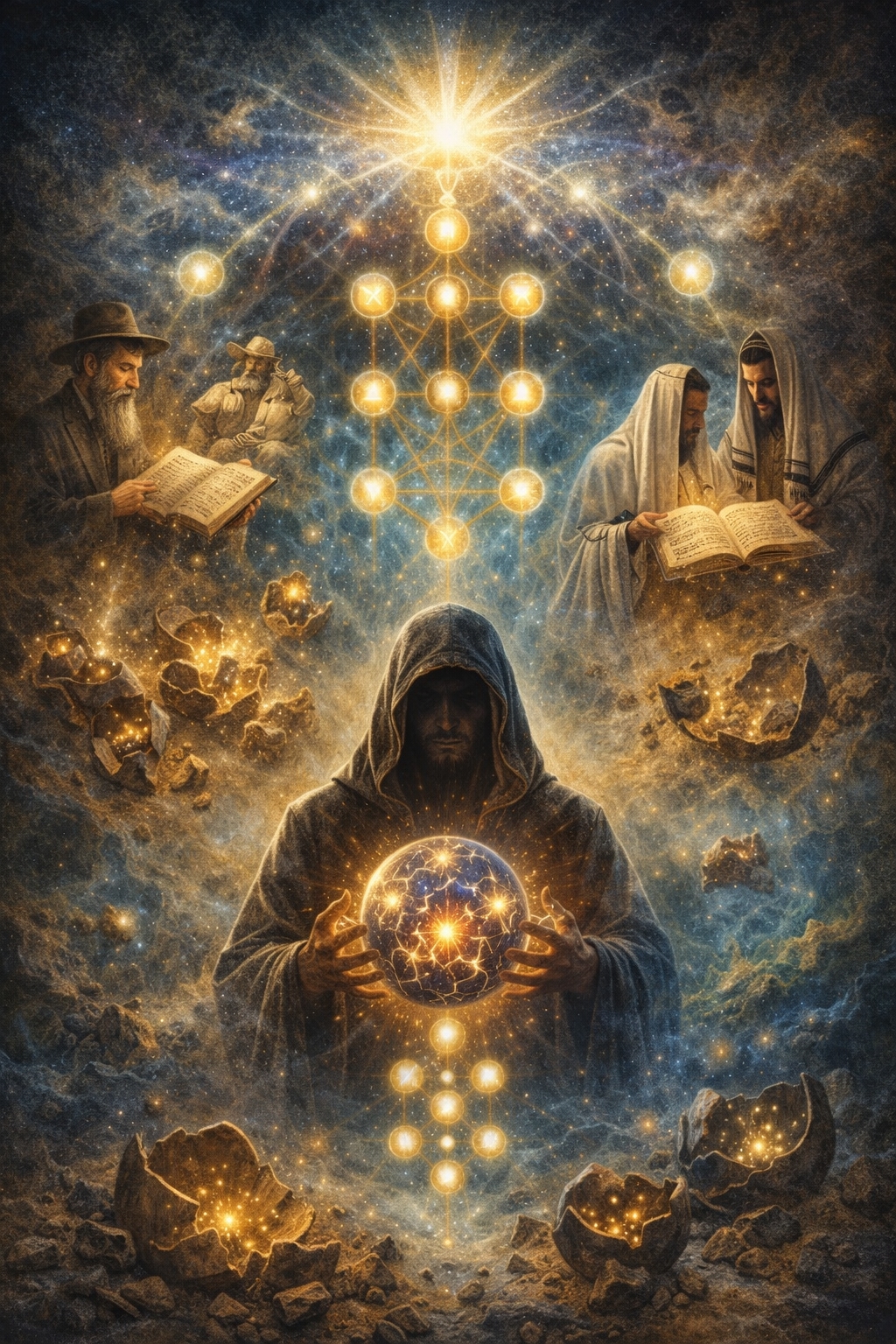
The Zohar says you contain divine sparks. Fragments of infinite light trapped in matter, waiting for liberation. The breaking of vessels scattered God’s light throughout creation, and now those sparks live inside you, inside everything. Your soul is a spark of Ein Sof, the infinite unknowable that has no form, no limit, no end.
This sounds like identity. Sounds like you and God share substance. Sounds like the mystics saying what mystics always say: the divine isn’t elsewhere, it’s here, it’s you.
But Kabbalah immediately corrects this impression.
The Refusal
You have sparks, yes. But you are not divine. You emanated FROM the infinite. You are not identical WITH the infinite.
The distinction matters. Emanation creates hierarchy. Creates distance. Between the Ein Sof and you stand the sephirot, ten emanations that mediate divine energy downward through increasingly dense levels of reality. Crown, wisdom, understanding, mercy, judgment, beauty, eternity, splendor, foundation, kingdom. Each one a step away from the source.
You exist at the bottom of this cascade. The sparks descended through multiple levels of reality before they reached you. They passed through celestial realms, angelic hierarchies, cosmic structures. By the time they arrived in your body, they had traveled so far from the source that claiming identity with Ein Sof would be absurd. Heretical, even.
The Lurianic tradition doubles down through shevirat ha-kelim—the breaking of vessels. Divine light was too intense for the containers meant to hold it, so the vessels shattered, scattering sparks throughout creation. Those sparks fell into kelipot, husks of impurity that trap them. Your work—tikkun olam, repair of the world—is to liberate those sparks and return them to their source.
Notice what this narrative does. It turns potential identity into a project. The sparks are trapped. Imprisoned. Covered in shells. Your job is to free them through prayer, study, ethical action, mystical contemplation. The more you follow the tradition, the more sparks you elevate.
You’re a vehicle. A temporary host. A worker in the cosmic repair shop.
What the Refusal Protects
First, it protects Jewish monotheism. If you claimed identity with Ein Sof, you’d be claiming to be God. Islam executed al-Hallaj for saying “Ana al-Haqq.” Christianity burned Meister Eckhart’s writings for suggesting God is born in the soul. Judaism has the same allergy to direct divine claims. The tradition survived two thousand years of persecution by maintaining absolute distinction between God and humanity. Kabbalah can’t erase that boundary no matter how mystical it gets.
Second, it protects rabbinic authority. If you’re already divine, what do you need teachers for? But if divine light is trapped inside you, covered in husks, scattered and confused, then you need expert guidance. You need someone who knows which prayers elevate which sparks. Someone who studied the sephirot, understands the cosmic architecture, can navigate the descent and ascent of divine energy.
The esoteric/exoteric distinction depends on this. Not everyone can study Kabbalah. The Talmud says you must be male, over forty, married, well-versed in Torah and Talmud. These restrictions exist because the knowledge is dangerous. If you’re not ready, mystical study will break your mind. You’ll claim divinity inappropriately. You’ll confuse emanation with identity. You’ll skip the necessary stages.
So rabbinic authority functions as gatekeeper. The rabbi decides when you’re ready. The rabbi determines if you’ve done enough exoteric work to approach the esoteric. The rabbi interprets the symbols, explains the diagrams, prevents you from drawing heretical conclusions from mystical texts that constantly seem to suggest what they explicitly deny.
Third, it protects the work itself. If you’re already whole, why would you need tikkun olam? Why gather sparks if they’re not actually scattered? Why repair what isn’t broken?
The entire ethical and mystical system depends on the gap between where you are and where the sparks belong. You’re divine-in-exile. And exile requires return. Separation requires repair. Distance requires work.
The Alternative Nobody Speaks
What if the sparks aren’t trapped? What if emanation didn’t create distance but revealed what was always true? What if the Ein Sof can’t be separate from anything because infinity doesn’t have an outside?
The Kabbalists came close to this. They said Ein Sof has no qualities, no attributes, no distinction between substance and essence. They said everything that exists is a manifestation of the infinite. They said the divine light permeates all reality.
But then they built the sephirot as a buffer. They created cosmic catastrophe to justify cosmic repair.
The mystics who said the breaking wasn’t actual fragmentation—just the appearance of multiplicity—got accused of pantheism. Of collapsing the necessary distinction between Creator and creation. Of threatening the entire structure.
Because if there’s no real distance, then there’s no mediation. No hierarchy. No levels you must ascend. No qualification requirements. No esoteric circle guarded by authorized teachers. No cosmic work project that takes lifetimes.
Just the infinite, being what it always was, appearing as everything including you.
The refusal protects against this possibility. You descended from the source, but you are not the source. You will return, but you are not already there.
The sparks wait for liberation. The vessels wait for repair. And between the waiting, the tradition survives.