
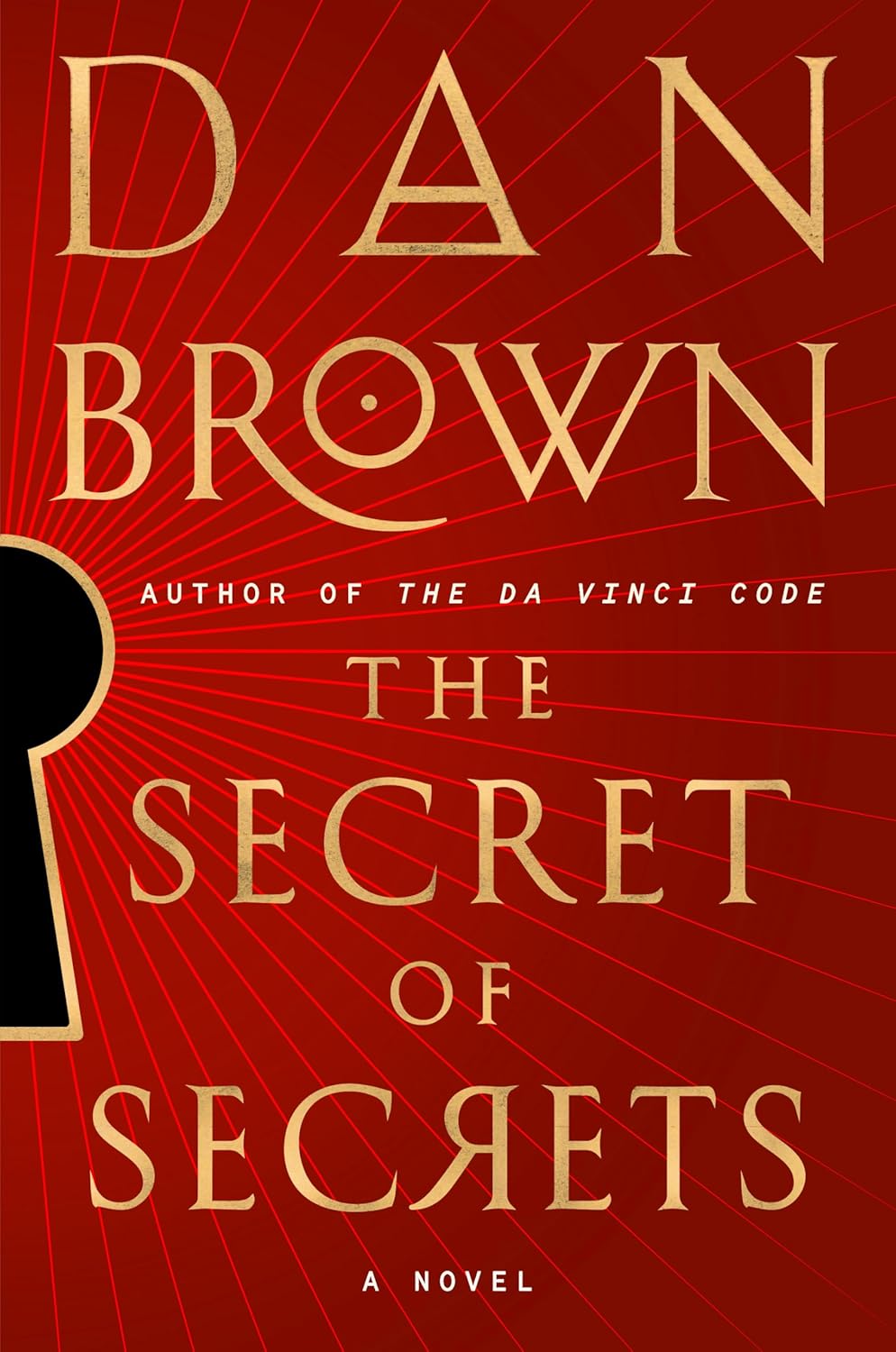
The Secret of Secrets is exactly the Dan Brown thriller you expect: Harvard symbologist Robert Langdon racing through Prague with his girlfriend Katherine Solomon—a noetic scientist who’s disappeared along with her manuscript about consciousness. There’s a villain dressed as the Golem, a CIA black site experimenting on human subjects, chase scenes, explosions, the formula.
But the book’s real subject is what Katherine’s research claims: that consciousness doesn’t originate in the brain. The brain is a receiver. Consciousness permeates the universe like a field, and your neural tissue tunes into specific frequencies of that field. When your body dies, you don’t lose consciousness—you lose the receiver that was filtering universal consciousness down into individual experience.
Brown grounds this in noetic science—the study of consciousness, which Katherine argues is actually the oldest science. Every culture has explored these questions. Every tradition developed practices to investigate the nature of awareness, the soul, what persists after death. We’ve just stopped calling it science and started calling it religion.
The book walks through the evidence: halos appearing across all spiritual traditions—Jesus, Buddha, Hindu deities, the ancient Egyptian sun disk over Ra, Moses’s “hila” of light, the Statue of Liberty’s radiant crown. Not metaphor. Markers of enlightened consciousness. Different cultures recognizing the same phenomenon.
Katherine’s lectures hit the core claim directly: “Your brain is just a receiver—an unimaginably complex, superbly advanced receiver—that chooses which specific signals it wants to receive from the existing cloud of global consciousness.” When the body fails, “you no longer need your body to receive the signal…you are the signal.”
Brown threads this through ancient wisdom. Buddha: “With our thoughts, we create the world.” Jesus: “Whatever you ask for in prayer, it will be yours.” Hinduism: “You have the power of God.” Not commands from external deities. Descriptions of how consciousness works.
The book’s villain embodies the counterpoint—someone who understands these truths but has detached from the ethical framework that should accompany them. Understanding that the body is temporary doesn’t automatically produce wisdom. It can just as easily produce nihilism.
And Brown explores the shadow side honestly. Katherine notes that fear of death—what she calls “mortality salience”—drives much of human dysfunction. The more we fear death, the more we cling: to possessions, to nationalism, to racism, to religious intolerance. We become selfish, materialistic, environmentally destructive. “We sense the planet is a lost cause and we’re all doomed anyway.”
The ancient saying surfaces: Timor mortis est pater religionis. Fear of death is the father of religion. We created afterlife narratives as “a shared delusion…to make our actual life bearable.” But what if those narratives contain fragments of something real? What if “the age-old promise of eternal life might actually predate religion…finding its roots in the lost wisdom of the ancients…a time when the human mind was sufficiently uncluttered to perceive the deepest truths”?
The Hermann grid appears early—a visual illusion where black dots seem to appear and disappear depending on where you focus. Katherine uses it to demonstrate that “human perception is riddled with blind spots. Sometimes we’re so busy looking the wrong way…that we don’t see what’s right before our eyes.”
That becomes the book’s real argument. We’ve dismissed consciousness research as pseudoscience, relegated it to the margins, because we’re looking the wrong way. Materialist neuroscience keeps trying to explain how neurons produce consciousness—the “hard problem”—without considering that maybe they don’t. Maybe consciousness is fundamental, and matter is what emerges from it rather than the reverse.
Does Brown execute this well? No. The thriller mechanics overwhelm the concepts. The CIA conspiracy plot feels grafted on. Katherine’s research deserves a different container than a race through Prague being chased by someone in a Golem costume.
But the ideas themselves—those land. Brain as receiver. Consciousness as non-local. Death as liberation of signal from receiver. These aren’t new. They’re ancient. And they’re worth sitting with regardless of how clumsy the packaging.
The book ends where it begins: with the possibility that what we call death might not be an ending at all. Just a change in how consciousness interfaces with reality. The dust returns to the ground, and the spirit returns home.
That’s not a bad question for a thriller to ask, even if it stumbles asking it.