
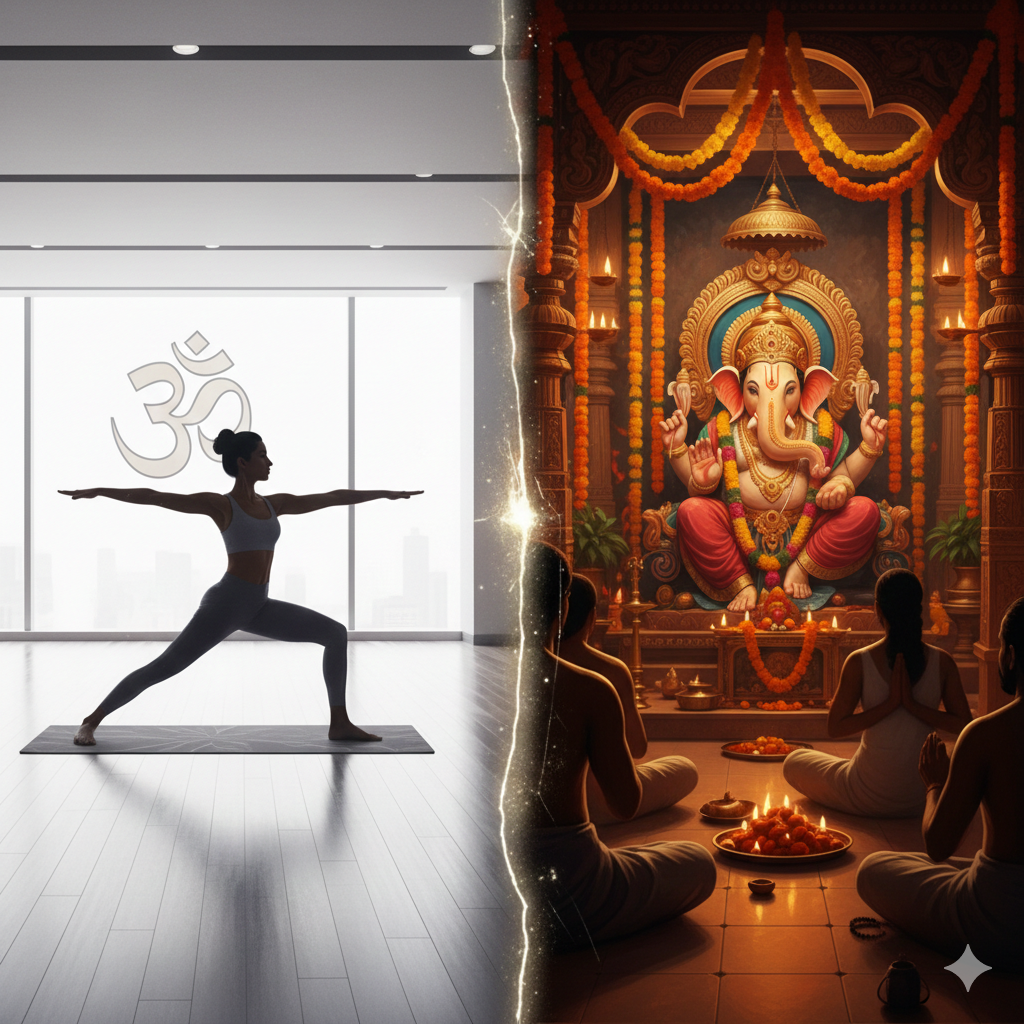
You roll out your mat. Light some incense. Maybe there’s a Buddha statue in the corner of the studio (never mind that Buddha wasn’t Hindu). The instructor guides you through sun salutations, warrior poses, savasana. You end in child’s pose while she walks around saying “namaste” and ringing a singing bowl.
This costs you $25 for the drop-in class. Your mat cost $80. Those pants? $120. You go twice a week. You feel centered. Connected. You’ve been practicing for three years.
You’re doing yoga.
Except you’re not. You’re doing asana—postures. Which is one-eighth of yoga. One piece of a comprehensive Hindu spiritual system designed to lead you to moksha: liberation from the cycle of death and rebirth through union with the divine.
The other seven limbs? You’ve never heard of them. The religious framework? Carefully removed. The Hindu practitioners who actually practice the complete system? You keep your distance.
What Yoga Actually Is
The Yoga Sutras of Patanjali, compiled around 400 CE, lay out the Eight Limbs of yoga:
- Yama (ethical restraints): Non-violence, truthfulness, non-stealing, sexual restraint, non-possessiveness
- Niyama (observances): Purity, contentment, discipline, self-study, surrender to God
- Asana (postures): Physical poses to prepare the body for meditation
- Pranayama (breath control): Breathing techniques to control life force energy
- Pratyahara (withdrawal of senses): Turning inward, away from external stimuli
- Dharana (concentration): Focusing the mind on a single point
- Dhyana (meditation): Sustained concentration leading to meditative absorption
- Samadhi (union): Complete absorption, union with the divine
Notice where asana falls? Third. It’s preparation. The whole system leads to samadhi—union with Brahman, the ultimate reality in Hindu philosophy. The postures exist to make your body capable of sitting still long enough to meditate. The meditation exists to bring you to God.
We took item three, removed the theology, added some Sanskrit words we can’t pronounce, and built a $12 billion industry.
What Got Lost in Translation
Those sun salutations you do every class? “Surya Namaskar”—salutation to Surya, the sun god. You’re performing devotional practice to a Hindu deity.
“Namaste”—the greeting your instructor says while bowing with hands in prayer position? It means “the divine in me honors the divine in you.” Acknowledgment of shared divinity, a Hindu theological concept. We use it to mean “thanks for coming to class.”
The poses themselves: Hanumanasana, named for the monkey god Hanuman. Natarajasana, for Nataraja, the dancing form of Shiva. Garudasana, for Garuda, the eagle vehicle of Vishnu. You’re moving your body into shapes that honor Hindu gods.
The breathing techniques? Pranayama means “control of prana”—life force energy flowing through nadis (energy channels) and collecting at chakras (energy centers). The whole system assumes the body is animated by divine energy, capable of kundalini awakening—the rising of shakti energy from the base of the spine to the crown, bringing spiritual liberation.
This isn’t vague spirituality. It’s specific Hindu cosmology. And we’ve stripped it all away to sell flexibility and stress relief.
The Industry We Built
American yoga generates $12 billion annually. Lululemon’s market cap exceeds $40 billion. You can buy yoga mat bags, yoga towels, blocks, straps, bolsters, special clothes that cost more than regular athletic wear. Yoga studios in every affluent neighborhood. Retreats in Bali. Teacher training certifications. Instagram influencers.
Meanwhile, Hindu temples in America struggle for funding. Hindu priests often work second jobs. Hindu community centers operate on shoestring budgets.
We commodified a Hindu spiritual practice, made it accessible only to people who can afford premium pricing, and created our own class hierarchy. When Hindus point out the extraction? We insist we’re honoring the tradition. Sharing the wisdom. Making it accessible.
We’re taking their religious practice and selling it back to them without the religion.
The Religion We Avoid
There are 450 million Hindus worldwide. About 2.5 million in the United States. They have temples. They worship there. They perform puja—devotional rituals to deities. They celebrate Diwali, Holi, Navaratri. They read the Bhagavad Gita, the Upanishads, the Vedas.
They worship Ganesha, the elephant-headed remover of obstacles. Lakshmi, goddess of prosperity. Hanuman, the devoted monkey god. Durga, the warrior goddess. Shiva, destroyer and transformer. Vishnu and his avatars, including Krishna and Rama.
To us, this looks like superstition. Like they haven’t evolved to the sophisticated, non-theistic, purely philosophical understanding we prefer.
We love the Bhagavad Gita’s wisdom about karma and dharma. We get uncomfortable when Krishna—speaking the Gita—is presented as God incarnate who should be worshiped. We’ll quote “Tat Tvam Asi” (Thou art That) from the Upanishads. We avoid the Brahmins, the elaborate rituals, the belief in reincarnation based on karma accumulated across lifetimes.
If you actually studied Patanjali’s complete system, you’d discover the entire practice is designed to lead you to union with Ishvara—the Lord, God. The first niyama is surrender to God. The goal isn’t flexibility or stress management. It’s samadhi—the death of the ego, absorption into ultimate reality, liberation from the cycle of rebirth.
That’s not spiritual-but-not-religious. That’s religious. With deities and devotion and ritual and community and theological demands.
The Caste Problem
The caste system is real. The harm is real. Thousands of years of birth-based hierarchy. Brahmins at the top, Dalits—formerly “untouchables”—at the bottom. Discrimination, violence, oppression that continues today despite laws against it.
Hindu reformers are fighting caste. Dalit activists are demanding justice. It’s a serious, ongoing struggle within the tradition.
But our avoidance of Hindus isn’t motivated by ethical concern about caste. If it were, we’d be supporting Dalit activists. Learning from Hindu reformers. Engaging with the complexity.
Instead, we extract yoga, ignore the religion, feel vaguely superior about avoiding something “problematic,” and build yoga studios in wealthy neighborhoods that serve almost exclusively white, affluent practitioners.
We cite caste as justification for extraction while creating our own class barriers. That’s not ethical engagement. That’s convenient excuse-making.
The Gap
What would it mean to actually honor yoga’s origins?
Maybe it means acknowledging we’re practicing asana-plus-meditation, which is valuable but not the complete system. Maybe it means getting curious about Hindu temples instead of avoiding them. Understanding that devotion to deity isn’t primitive—it’s a sophisticated theological choice. Supporting Hindu communities and their religious institutions instead of just paying for studio classes that sell their practice back to them without the religion.
Or maybe it just means being honest: our preference for non-theistic yoga isn’t more evolved. It’s more comfortable. Less demanding. Easier to commodify. We benefit from Hindu practice while avoiding Hindu practitioners. We feel spiritual without being religious. We extract the parts we like while dismissing the people who gave us the tradition.
That’s not honoring yoga. That’s colonizing it.
The Distance continues next week: The Guru Problem