
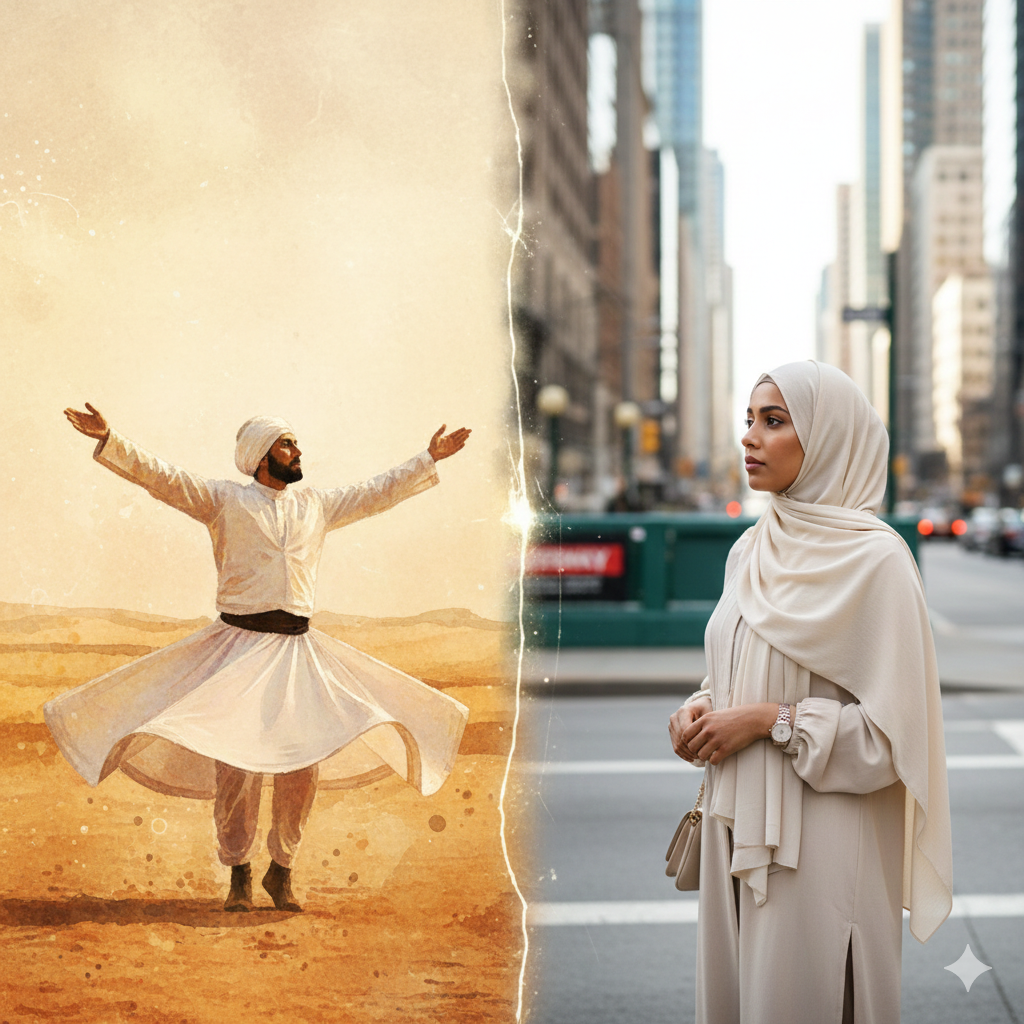
“Let yourself be silently drawn by the strange pull of what you really love. It will not lead you astray.”
We quote Rumi at weddings, on greeting cards, in social media posts. The poetry feels universal, transcendent, safely spiritual without being religious. Perfect for people who want wisdom without the weight of tradition.
But Rumi—Jalāl ad-Dīn Muhammad Rūmī—was a 13th-century Islamic scholar, jurist, and theologian. He prayed five times daily. He taught Sharia law. His poetry emerges from deep immersion in Quranic study and Islamic practice. The whirling that Westerners find so photogenic? That’s dhikr—remembrance of Allah through movement and breath.
His masterwork, the Masnavi, is called “the Persian Quran.” It contains over 2,000 direct references and allusions to the Quran and models itself on Quranic rhetoric and structure. Rumi himself described it in his Arabic introduction: “This is the book of the Masnavi and it is the roots of the roots of the roots of the (Islamic) Religion… and it is the Illuminator of the Qur’ân.”
Hafez of Shiraz wrote ghazals saturated with Quranic imagery. His pen name—Hafez—means “one who has memorized the Quran,” which he accomplished at an early age. His most famous ghazal opens in classical Arabic: “Alā yā ayyuhā ‘s-sāqī adir ka’san wa-nāwilhā” (Come, cupbearer, pass the cup around). Every line assumes familiarity with Islamic theology, Persian poetic convention, and Sufi spiritual practice. His tomb is a pilgrimage site where Muslims pray.
Attar’s Conference of the Birds is an Islamic allegory. The title comes directly from Quran 27:16, where Solomon is said to have understood the language of birds. The seven valleys the birds cross aren’t abstract spiritual territory—they’re specific Islamic Sufi stages with Arabic names: Talab (Yearning), Eshq (Love), Marifat (Gnosis), Istighnah (Detachment), Tawheed (Unity of God), Hayrat (Bewilderment), and Fana (Annihilation in Allah). The hoopoe leading the birds toward the Simurgh is guiding souls toward annihilation in Allah. The practice that enables this journey? Dhikr—the Islamic remembrance of God through repetition of His ninety-nine names.
These aren’t poets who happened to be Muslim. They’re Muslim poets. Islamic mystics. The distinction matters.
What Gets Stripped Away
Coleman Barks created the Rumi most Americans know. Working from literal translations, he rendered Persian poetry into lyrical English that became wildly popular. He also systematically removed Islamic context.
Take this famous verse. Barks’ version reads:
“Out beyond ideas of wrongdoing and rightdoing, there is a field. I’ll meet you there.”
Here’s the actual translation:
“Beyond Islam and unbelief there is a ‘desert plain.’ For us, there is a ‘passion’ in the midst of that expanse. The knower [of God] who reaches there will prostrate [in prayer], (For) there is neither Islam nor unbelief, nor any ‘where’ (in) that place.”
See the difference? The original is about transcending mental concepts about religion through direct mystical experience—while still prostrating in Islamic prayer. Barks made it about transcending morality itself. As Barks himself explained: “I took the Islam out of it.”
Or consider this verse, which isn’t even authentic Rumi but gets widely quoted:
“Not Christian or Jew or Muslim, not Hindu, Buddhist, sufi, or zen.”
The original reads: “What is to be done, O Moslems? for I do not recognise myself. I am neither Christian nor Jew, nor Gabr [Zoroastrian], nor Moslem.”
Barks added “Hindu, Buddhist, sufi, zen”—religions Rumi knew nothing about—to make it sound universally spiritual rather than specifically Islamic.
This isn’t unique to Barks. Most popular translations of Sufi poetry do similar work. We get the ecstasy, the longing, the beautiful metaphors about wine and taverns and love. We don’t get the Islamic framework those metaphors operate within.
The wine is often prohibited wine—the metaphor only works because drinking alcohol is forbidden in Islam. The tavern is the place of spiritual intoxication that contrasts with the mosque’s formal prayer. The beloved is sometimes God, sometimes the Prophet Muhammad, sometimes the spiritual guide. These aren’t universal symbols—they’re specific to Islamic Sufi practice.
We strip that specificity away to make the poetry accessible. Universal. Ours.
What the Poetry Asks
Read Rumi beyond the Instagram quotes and the demand becomes clear: complete surrender. Annihilation of the ego. Submission to divine will. The Arabic word “Islam” means submission—that’s not coincidental.
“Die before you die,” Rumi wrote. Not as metaphor but as instruction:
“I died as a mineral and became a plant, I died as a plant and rose to animal, I died as animal and I was man, Why should I fear? When was I less by dying?”
The mystic path requires letting the self dissolve into God. Everything you think you are—your opinions, your preferences, your carefully constructed identity—has to go.
Hafez writes about spiritual intoxication as losing all capacity for self-direction. The wine isn’t just joy—it’s obliteration of personal will. The hangover is waking up married to God with no memory of giving consent. The goal is to never sober up.
Attar’s birds undertake a journey that kills most of them. The ones who survive arrive at the Simurgh’s mountain only to discover the Simurgh was themselves all along—but transformed beyond recognition. Thirty birds (si morgh) become the Simurgh. Individual identity dissolves into collective divine reality. This is fana—annihilation in Allah.
This is not gentle wisdom. It’s not “follow your bliss” or “trust the universe.” It’s “die to yourself” and “surrender everything” and “let God consume you completely.”
The poetry asks for submission. Dissolution. Practices that require guidance, community, sustained commitment. It asks for Islam.
The Muslim Next Door
Then the Muslim family moves in next door.
They pray five times daily—sometimes we hear the call to prayer from their home. The women wear hijab when they go out. During Ramadan they fast from dawn to dusk. They’re friendly but also clearly different. Their lives are shaped by rules we don’t follow, practices we don’t share, a worldview that makes claims about ultimate reality.
Something in us hesitates. Not outright hostility—we’re not that. Just a subtle distance. A careful neutrality. If someone asks what we think of our Muslim neighbors, we say all the right things. But we don’t actually engage. Don’t get close. Don’t risk relationship that might demand we take their practice seriously.
Or we work with Muslims and notice how we mentally categorize them. The “moderate” ones who don’t make their religion too visible. The “traditional” ones who seem stuck in the past. The tension when they need a prayer space at work or want time off for Islamic holidays.
Or we watch news coverage of Islam and notice which voice we trust. The Muslim scholar explaining Sufism as Islamic mysticism? Too biased, probably. The white academic explaining how Sufism transcends Islam? That sounds more objective.
The contradiction lives in our bodies. Love Rumi—absolutely. Quote him constantly. Post his poetry during difficult times. But move a little further away on the subway when we see someone who’s visibly Muslim. Support the Muslim ban because “terrorism” while keeping that Rumi book on the nightstand. Appreciate Sufi wisdom while viewing actual Islamic practice with suspicion.
When Aesthetic Becomes Demand
We love the wisdom when it asks nothing of us. When we can consume the poetry without encountering the practitioners. When surrender means “let go and trust” rather than “submit to Allah and pray five times daily.”
The poets we love practiced within communities. They had teachers who required obedience. They followed rules we’d find restrictive. They prayed in ways we’d call repetitive. They believed things we’d call dogmatic.
That’s what the distance protects us from.
If we took the poetry seriously—if we actually wanted what Rumi and Hafez and Attar are offering—we’d have to engage with Islam. Not necessarily convert, but engage. Learn what Quranic allusions mean. Understand why certain practices matter. Listen to Muslims about their own tradition rather than extracting the parts we like while dismissing the people who actually live it.
We’d have to risk discovering that our Muslim neighbors praying five times daily are doing exactly what Rumi was doing. That the woman in hijab submitting to dress codes we find oppressive might be practicing the surrender Hafez celebrated. That the imam teaching Sharia law might be offering the guidance Attar said we need.
We’d have to let the poetry make demands. Real demands. Not just “be more mindful” but “reconsider everything you think about religion, submission, and who counts as wise.”
The aesthetic is easier. Instagram quotes that inspire us without transforming us. Beautiful words that let us feel connected to ancient wisdom without having to actually connect with the people who preserved it, practiced it, live it.
The Gap
What would it mean to honor these poets by honoring their tradition? To treat Islam as the sophisticated spiritual system that produced this profound mystical poetry rather than the oppressive religion we need Sufism to transcend?
What would it mean to actually befriend our Muslim neighbors? Not just tolerate them—actually get close enough that their practice challenges our assumptions. Ask what their prayers mean. Learn what Ramadan teaches. Discover why hijab might be chosen rather than imposed. Risk having them explain Islam to us instead of us explaining Sufism to them.
What would it mean to recognize that the submission Rumi calls for and the submission our Muslim coworkers practice might be the same thing? That we can’t actually want one while dismissing the other?
The distance protects us from these questions. Keeps the poetry beautiful and the practitioners safely separate. Lets us love the wisdom without honoring the people who brought it forward, sustained it, live it.
The poets themselves would recognize the contradiction. They wrote about it—the tavern-haunter who performs piety while avoiding the drunkenness that true love demands. The scholar who knows all the texts but hasn’t let them burn away his careful self-protection.
We read those poems and think they’re about other people.
They’re about us.
The Distance continues next week: The Yoga We Practice, The Hindus We Ignore