
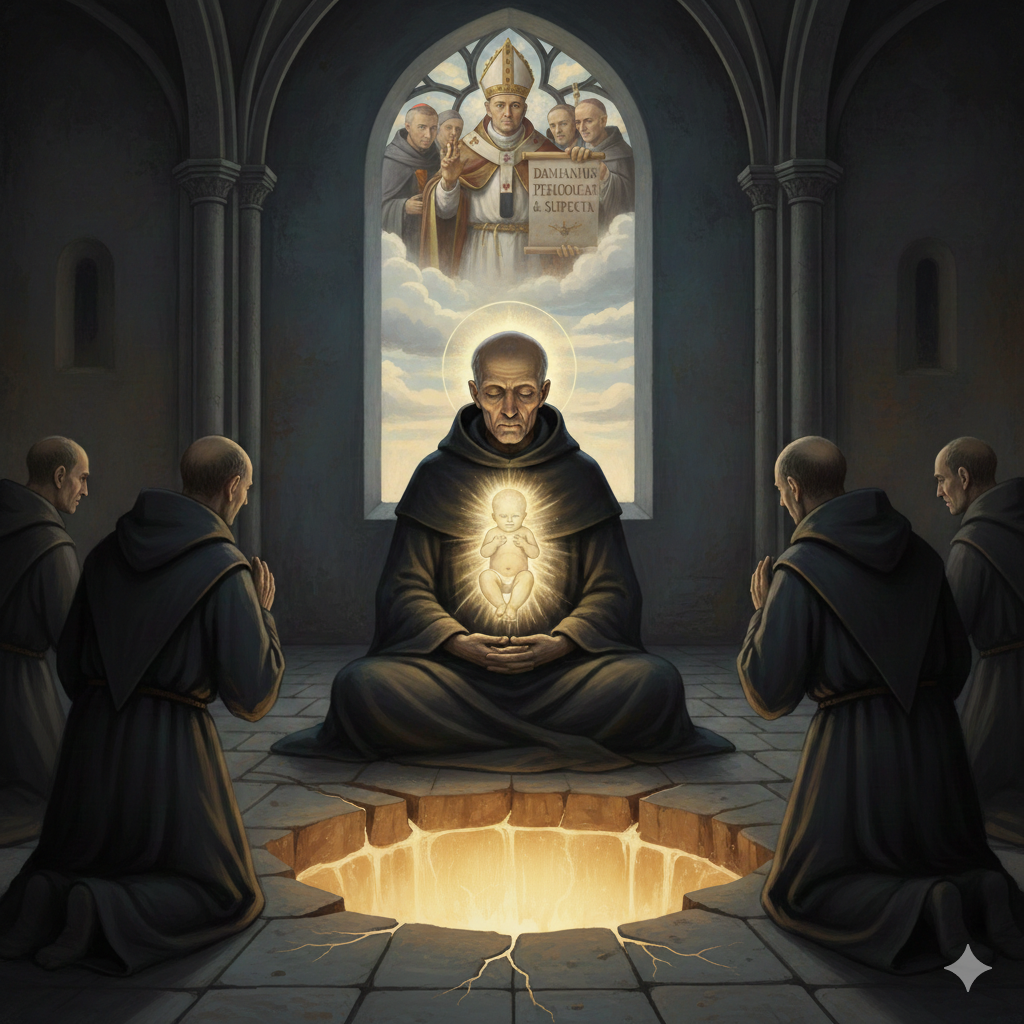
Meister Eckhart preached in 14th century Germany that God is born in the soul. Not metaphorically. Not eventually. Right now, in the ground of who you are.
“God’s ground is my ground and my ground is God’s ground.”
The soul and God share the same foundation. At the deepest level—what Eckhart called the “spark” of the soul—there’s no distinction. The place where you are most yourself is the place where God is most present. Not dwelling within you as guest in house. Not loving you from outside. Actually sharing ground.
The Father gives birth to the Son in eternity. And that same birth happens in the soul. Not a different birth, not a lesser birth. The same eternal generation occurring in human consciousness.
“None can touch the ground of the soul but God.”
Because at that ground, there’s no separation. God enters the soul “with his all, not merely with a part.” The essence of the soul is intrinsically receptive to nothing but divine essence. No intermediary. No gap.
It’s one of the most radical statements in Christian mysticism. The human soul, at its core, is where God is continuously being born.
And then Eckhart adds the qualifications.
To experience this birth, you need Gelassenheit—detachment. Total letting-go of self-will, ego, attachment to created things. You must empty yourself so completely that “you no longer stand in the way of the One.”
The soul moves through stages. Dissimilarity first—recognizing that creatures are “pure nothingness” compared to God’s being. Then similarity—discovering you’re made in God’s image, reflecting divine qualities. Then identity—the intimate oneness where “God’s being is my being.” Finally, breakthrough—going beyond even God to the Godhead, the origin of all things.
Notice what happened. “God is born in your soul” became “God is born in your soul after you’ve achieved total detachment and moved through all the stages and emptied yourself completely.”
From present reality to graduated path.
The Church noticed too.
In 1326, the Archbishop of Cologne initiated an inquisitorial process against Eckhart. Twenty-eight propositions from his teachings were eventually condemned by Pope John XXII in 1329—the year after Eckhart died—as either heretical or “dangerous and suspect.”
The main charges: He claimed the soul was partly uncreated and divine. He suggested people could achieve the same union with God that Christ had. He blurred the Creator/creature distinction. He threatened Christ’s unique status as the only God-man.
Eckhart defended himself by distinguishing error from heresy: “I may err but I am not a heretic, for the first has to do with the mind and the second with the will.”
He wasn’t claiming the soul becomes God in substance. He was describing operational unity—God’s action and the soul’s becoming as one. When you empty yourself enough, when you achieve complete detachment, you realize what was always true: “The Father and I are one.”
But that defense itself contains the refusal.
By making the recognition of divine ground dependent on emptying, detachment, stages of realization, Eckhart created the gap the Church could work with. Yes, God is born in your soul—but only after you’ve died to everything else. Only after you’ve let go of self, will, attachment, even your own existence as separate being.
The birth requires your death.
And who decides when you’ve died enough? When you’ve achieved sufficient detachment? When you’ve moved through the stages properly? When the birth has actually occurred?
The tradition. The lineage. The Church that’s meant to guide you toward what Eckhart said was already happening.
Christian mysticism across centuries follows this pattern. Teresa of Avila describes the soul’s interior castle with seven mansions—stages of increasing intimacy with God culminating in spiritual marriage. But you must move through each mansion sequentially, guided by proper spiritual direction, following the path the tradition maps.
John of the Cross writes of the dark night—the stripping away of all attachments, all consolations, all sense of God’s presence—as necessary purification before union. The suffering is required. The emptying is essential. The death must be complete before the birth can happen.
Pseudo-Dionysius, centuries before Eckhart, developed the apophatic way—knowing God only through negation, through what God is not. God is beyond all names, all concepts, all human knowing. You approach through via negativa, stripping away every false image until you’re left with divine darkness, unknowing.
All brilliant theological systems. All describing genuine mystical experiences. All true on their own terms.
And all introducing the mechanism that makes direct recognition of divine ground require mediation.
You can’t just know God is born in your soul. You must be guided through detachment. You must move through stages. You must empty yourself under proper spiritual direction. You must distinguish between false and true experiences of union. You must recognize that your sense of self is illusion while simultaneously working to perfect that self through virtues.
What does Christian mysticism protect through this refusal?
The Church’s authority as necessary mediator between human and divine. The unique status of Christ—the only one who is God and human without need for path or purification. The Creator/creature distinction that makes worship, obedience, and institutional hierarchy theologically necessary. The sacramental system that channels grace through proper channels.
If God is already born in your soul, what’s the Church giving you? If the ground you share with God requires no preparation to be what it is, why do you need spiritual direction? If your core identity is divine, why do you need salvation?
The mystics see it. They describe it in language that keeps approaching the edge: “I am what God is and God is what I am.” They experience states where all boundaries dissolve, all distinctions vanish, all separation ends.
And they translate it back into safe categories. Stages. Practices. Detachment. Emptying. Death before birth.
Never simple recognition. Never just: God is born in your soul, right now, requiring nothing.
Even Eckhart’s most radical statements get reframed. The “birth of God in the soul” becomes spiritual awakening accessible only through years of contemplative practice. The ground shared by soul and God becomes something you access through proper method rather than something you are.
The Church condemned him anyway.
Because even with all the qualifications, even with all the stages and detachment requirements, Eckhart came too close to saying what Christian orthodoxy cannot structurally accommodate: humans at their core are not separate from divine reality.
The refusal isn’t in denying mystical experience. It’s in the gap between being and becoming. Between the ground you share with God and the path required to realize it. Between the birth that’s happening now and the death you must achieve first.
That gap is where Christian mysticism builds its entire architecture of spiritual direction, contemplative practice, stages of perfection, discernment of spirits, and proper guidance.
Close the gap, and there’s nothing left to direct.
The birth of God in the soul remains. Mystics keep describing it. Churches keep managing it through requirements, stages, proper channels.
Same refusal. Different language.
You are where God is born—but only after you die. And the tradition decides when you’re dead enough.