
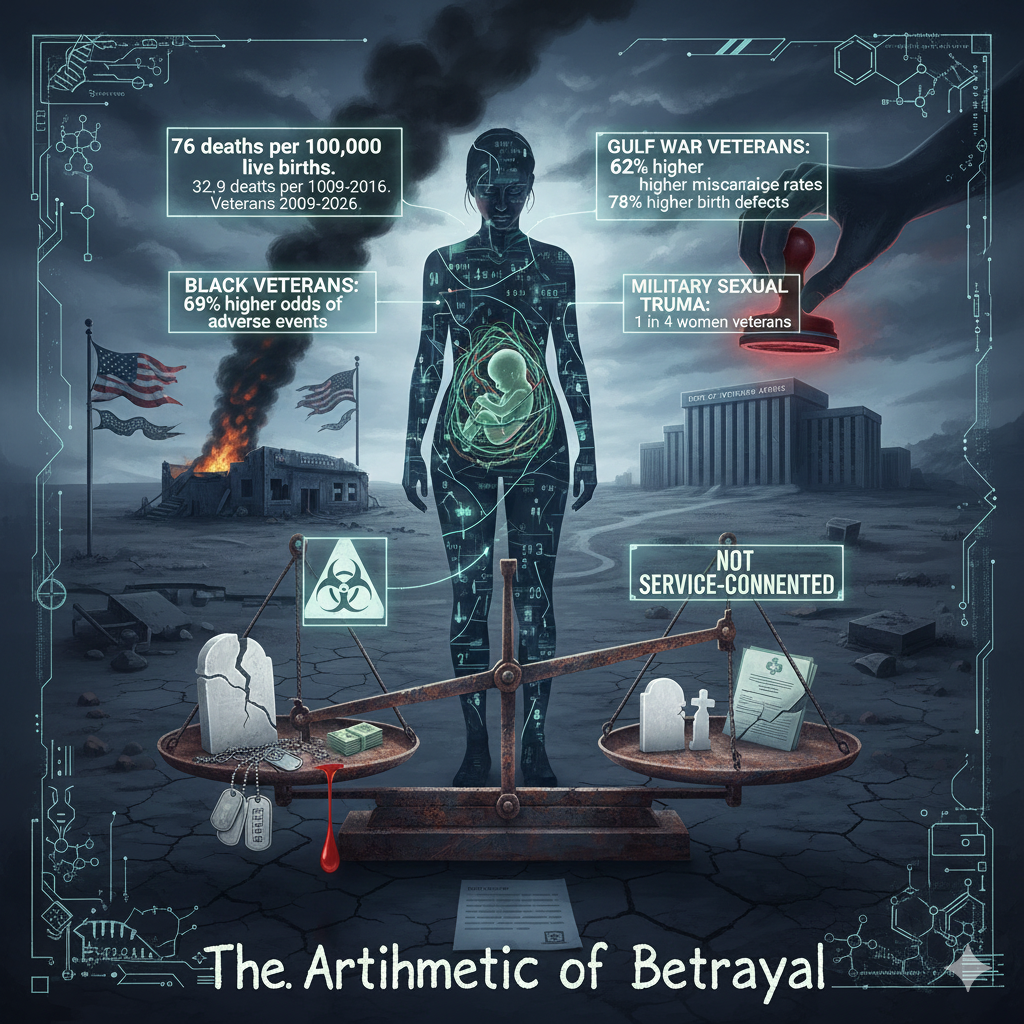
The Department of Veterans Affairs reinstated a near-total abortion ban on December 29, 2024. The policy eliminated exceptions for rape and incest. The House Committee on Veterans’ Affairs defended this by claiming “VA’s sole focus should always be providing service-connected health care.”
This is where language becomes violence. Where bureaucratic precision obscures body count. Where the term “service-connected” means whatever absolves the institution of responsibility for what it did to the bodies it deployed.
Let’s count what service actually connects to.
The Numbers They Don’t Want Adjacent
76 deaths per 100,000 live births. That’s the pregnancy-associated mortality rate among veterans using VA maternity benefits between 2009-2016.
32.9 deaths per 100,000 live births. That’s the general U.S. population rate in 2021.
Women veterans die from pregnancy at more than twice the rate of civilians. This isn’t random variation. This isn’t individual choice. This is what happens when you deploy bodies into toxic environments and then call the consequences “personal health issues” rather than service-connected harm.
Between fiscal years 2011-2020: 13 veteran deaths from pregnancy-related causes out of approximately 40,000 VA-paid deliveries. Eleven of those deaths were white women. The severe maternal morbidity rate nearly doubled during this same period—from 93.5 per 10,000 deliveries in 2011 to 184.6 per 10,000 in 2020.
Black veterans bear compounded harm: 69% higher odds of adverse pregnancy events than white veterans. Highest rates of severe maternal morbidity. And now, no access to abortion even when pregnancy results from rape.
The VA documents this. Studies it. Tracks it across decades. Then calls abortion access “not service-connected.”
What Deployment Does to Future Children
Male Gulf War veterans fathered children with:
- 62% higher miscarriage rates than non-Gulf veteran controls
- 78% higher rates of moderate-to-severe birth defects
- 50% higher rate of any malformation (UK study)
Female Gulf War veterans experienced:
- 180% higher rate of moderate-to-severe birth defects in their children
- 31% had pregnancies ending in miscarriage or stillbirth
- 25% had difficulty conceiving
- 23% had high-risk pregnancies
- 16% diagnosed with pre-eclampsia (versus 4% in general population)
Vietnam veteran fathers: children with 5.1 times higher risk of hydrocephalus, 3.1 times higher risk of hypospadias.
Vietnam veteran mothers: 46% higher rate of moderate-to-severe birth defects in their children.
These aren’t abstract statistics. These are children born with renal anomalies, cerebrospinal malformations, urinary system defects, digestive system abnormalities. These are pregnancies that never made it to term. These are bodies—veteran bodies, future children’s bodies—bearing the physical inscription of what the military insisted was safe.
Agent Orange. Burn pits. Chemical weapons exposure. Depleted uranium. The military said: trust us. The veterans’ bodies said: here’s what you did. The children’s bodies said: here’s what you did. The policy now says: manage the consequences without the healthcare tools that might help.
When Service Itself Becomes the Site of Violation
Military Sexual Trauma affects approximately 1 in 4 women veterans. The rape happened during service. Under military authority. Often by fellow service members or commanding officers.
Now the policy says: if pregnancy results from that service-connected sexual violence, you have no right to abortion access through VA care.
Think about what this means. A woman serves. She’s assaulted during that service—an experience the VA itself categorizes as Military Sexual Trauma, acknowledging it as a service-connected condition. She becomes pregnant from that assault. The VA now says: we’ll document your MST, we’ll provide mental health treatment for your PTSD from the assault, but we won’t provide abortion access for the pregnancy that resulted from it.
The violence gets categorized as service-connected. The pregnancy resulting from that violence does not.
This is bureaucratic gaslighting at the policy level.
The PTSD-Pregnancy Connection They Don’t Want You Making
PTSD increases risk of:
- Spontaneous preterm birth
- Preeclampsia
- Gestational diabetes
Deployment increases risk of PTSD. Combat exposure, witnessing death, military sexual trauma, moral injury—all documented pathways from service to PTSD.
Women veterans are more likely than non-veterans to have adverse childhood experiences including sexual abuse. They face unique deployment-related traumas. Then they face pregnancy with all the compounded risk that trauma history creates.
The chain of causation is direct: Service → Trauma → PTSD → Increased pregnancy complications.
But the policy calls abortion access “not service-connected” while simultaneously documenting every link in that causal chain.
What “Service-Connected” Means When They Mean It
The VA compensates veterans for:
- Exposure to Agent Orange and resulting health conditions
- Burn pit exposure and respiratory illness
- Gulf War Syndrome
- PTSD from combat or military sexual trauma
- Any condition that developed during or was aggravated by military service
The VA has spent decades studying reproductive harm among veterans. They know Gulf War deployment correlates with elevated miscarriage rates. They know exposure to toxicants causes birth defects. They know PTSD increases pregnancy complications. They document it. They publish it. They present it at medical conferences.
But when it comes to providing healthcare that might prevent some of that documented harm—abortion access for high-risk pregnancies, for pregnancies resulting from service-connected sexual trauma, for pregnancies in bodies already compromised by deployment exposures—suddenly the connection to service disappears.
The term “service-connected” means: whatever the institution is willing to take responsibility for. And that ends precisely where women veterans’ reproductive autonomy would begin.
The Exception That Swallows Itself
The current policy allows abortion only when “the life or health of the pregnant veteran would be endangered if the pregnancy were carried to term.”
Every pregnancy in a woman veteran with service-connected health conditions IS a pregnancy where life or health is endangered. The statistics prove it:
- Twice the maternal mortality rate of civilians
- Nearly doubled severe maternal morbidity rate in a single decade
- Black veterans at highest risk
- Gulf War veterans with dramatically elevated complication rates
- PTSD increasing risk of preterm birth and preeclampsia
But the policy forces veterans to wait until they’re actively dying before intervention is considered “necessary.” For a population already dying at twice the civilian rate, this isn’t healthcare. This is forcing women to play Russian roulette with their lives while calling it “protecting life.”
The cruelty is the point. The suffering is the policy.
What This Costs vs. What They’re Willing to Pay
The VA already pays for:
- Community-based prenatal care for approximately 4,000 veterans annually
- Labor and delivery
- Treatment for pregnancy complications
- Neonatal intensive care for premature births
- Long-term care for children born with severe birth defects
An abortion costs less than managing severe maternal morbidity. Less than NICU care for a preterm infant. Less than a lifetime of care for a child born with service-exposure-related birth defects. Less than a funeral.
This isn’t about money. It’s about control.
Specifically: controlling women veterans’ bodies while absolving the military of responsibility for the documented reproductive harm service has caused.
The Perverse Logic of Accountability
Here’s what the military and VA have done:
- Deployed women (and men) to toxic environments
- Documented elevated rates of miscarriage, stillbirth, and birth defects among their children
- Studied these outcomes for decades
- Published peer-reviewed research establishing the connections
- Created categories like “Gulf War Syndrome” acknowledging service-related illness
- Provided some disability compensation for service-connected conditions
Here’s what they won’t do:
Provide abortion access to manage the reproductive consequences of those same exposures.
The logic is perverse but precise: We’ll acknowledge we harmed you. We’ll study how we harmed you. We’ll compensate you for some of that harm. But we won’t give you the healthcare tools to prevent or manage ongoing harm to your reproductive capacity.
Compounding Harm
Approximately 4,000 veterans use VA maternity benefits each year. The pregnancy-associated mortality rate is 76 per 100,000 live births. That’s roughly 3 veteran deaths per year from pregnancy-related causes.
Three doesn’t sound like many until you remember:
- These are preventable deaths
- These are deaths in a population already at twice the civilian risk
- These are deaths among people who served
- These deaths could be reduced with comprehensive reproductive healthcare including abortion access
The VA operates 1,380 healthcare facilities nationwide. The infrastructure exists. The research documenting need exists. The connection to service is direct and documented.
What’s missing is willingness to extend “service-connected care” to mean: we take responsibility for all the ways service harms bodies, including reproductive harm, including the need for abortion access.
What the Silence Reveals
Where’s the outrage over the 31% of Gulf War veteran pregnancies that ended in miscarriage or stillbirth?
Where’s the accountability for children born with hydrocephalus at 5.1 times the normal rate because their veteran father was exposed to toxicants during deployment?
Where’s the Congressional hearing about why severe maternal morbidity among veterans nearly doubled in less than a decade?
The silence around service-caused reproductive harm is deafening. But the noise around denying veterans abortion access is constant.
This reveals everything about what actually matters to the institutions making these decisions. They’ll tolerate veteran bodies and children’s bodies bearing the marks of toxic exposure. They’ll document it, study it, publish papers about it.
But they won’t provide the healthcare that might give women veterans some measure of control over their own reproductive outcomes in the face of service-caused harm.
The Arithmetic Is Simple
You cannot simultaneously:
- Document that deployment causes elevated rates of reproductive harm
- Study those outcomes for decades
- Categorize some service-related conditions as worthy of compensation
- Then claim that managing reproductive harm including through abortion access is “not service-connected”
The math doesn’t work. The logic doesn’t hold. The only thing that makes sense is this: service-connected care means whatever allows the institution to avoid responsibility for what it did to women’s bodies.
What We Owe
When you send someone into a burn pit and their future children are born with birth defects, you owe them comprehensive reproductive healthcare.
When you document that 1 in 4 women veterans experienced military sexual trauma and then pregnancy results from that trauma, you owe them abortion access.
When you track that women veterans die from pregnancy at twice the civilian rate and develop severe complications at nearly double the rate they did a decade ago, you owe them every possible intervention to reduce that harm.
When you deploy someone to an environment so toxic their body will carry the consequences for the rest of their reproductive life, you owe them care that acknowledges that reality.
The VA says service-connected care is their focus. Then they need to be honest about what service connects to: birth defects, miscarriages, stillbirths, elevated maternal mortality, pregnancy complications, and the ongoing reproductive consequences of deployment exposures and military sexual trauma.
All of it is service-connected. All of it requires comprehensive care. Including abortion access.
The Bodies Keep Counting
76 per 100,000. 13 deaths in 10 years. 184.6 severe maternal morbidity cases per 10,000 deliveries. 31% pregnancy loss rate among Gulf War veterans. 69% higher odds of adverse events for Black veterans.
These aren’t just statistics. These are women who served. These are bodies the military deployed, exposed, sometimes assaulted. These are the physical consequences of decisions made by people who will never bear them.
And now, policy that says: we’ll document how we harmed you, but we won’t provide the care that might help you manage that harm.
The cruelty is precise. The math is simple. The bodies keep counting.
And “service-connected care” means whatever lets them look away.