
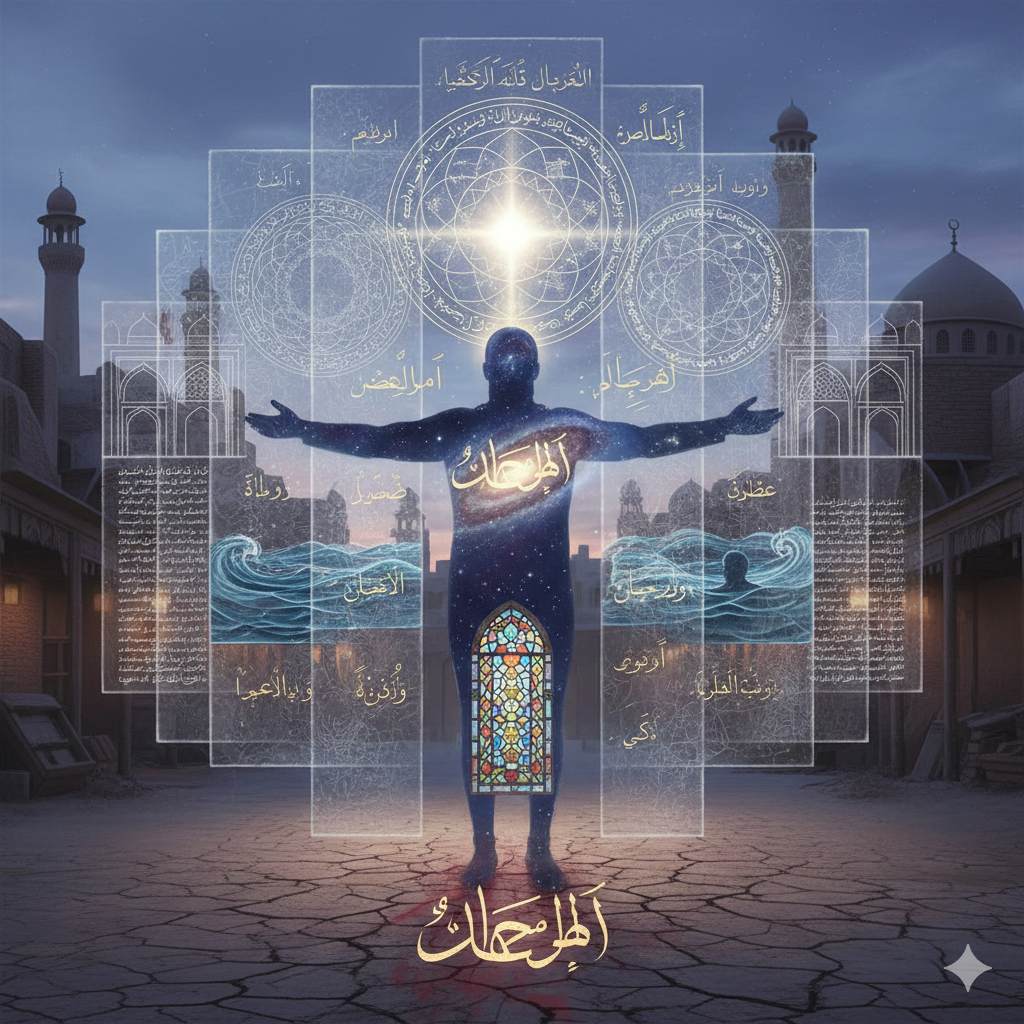
Al-Hallaj stood in the marketplace in Baghdad in 922 CE and said Ana al-Haqq—”I am the Truth.”
In Islamic tradition, Al-Haqq is one of the ninety-nine names of God. Not “a truth” or “truthful.” The Truth. Absolute. Divine.
They executed him for it.
Sufism—Islamic mysticism—has spent the last thousand years explaining why he was wrong. Or why he wasn’t really saying what it sounded like he was saying. Or why the statement was true but only in the specific context of complete ego dissolution that most people will never achieve.
The refusal is built into every explanation.
Here’s what Sufism teaches about divine union: The mystic progresses through stages called maqamat. Years of practice. Purification. Submission. Eventually, if you’re worthy, you experience fana—annihilation of the self. The ego dissolves completely.
What remains is only God.
This is presented as the highest achievement. The goal of the entire path. To become nothing so that only God exists in that space where you used to be.
But notice what just happened.
The tradition took you right to the edge of “I am divine” and then translated it into “I dissolved so God could occupy my empty space.” Identity became possession. Being became temporary occupation. Structural divinity became a state you achieve through spiritual bypass.
The Sufi masters are careful. They talk about baqa—subsistence in God after the annihilation. They explain that the mystic doesn’t claim divinity but recognizes that only God was ever real. The drop merged with the ocean. The wave recognized it was always just water.
Beautiful metaphors. All of them substituting union with for identity as.
Wahdat al-wujud—Ibn Arabi’s “unity of being”—gets close. All existence is one. Everything that appears separate is actually manifestation of the single divine reality. Matter, consciousness, you, me—all of it is God knowing itself through infinite forms.
But even Ibn Arabi stops short. The tradition preserves the distinction between God and creation even while describing their unity. Creation is God’s self-disclosure, not God itself. The mirror reflects the face but isn’t the face.
More metaphor. More refusal.
It’s there in the technical language. Tajalli—God’s self-disclosure. Not identity but manifestation. God showing through creation like light through colored glass. The glass isn’t the light. It only reveals the light by the light passing through it.
The refusal is in that metaphor. Glass revealing light versus glass being light.
What Sufism preserves through this refusal: Islamic monotheism, which cannot allow anything to share God’s unique reality. Teacher authority, which depends on some having achieved what others lack. The path itself, which requires the gap between what you are and what you can become through spiritual practice.
What it refuses to say: You are already the Truth. Not metaphorically. Not when your ego dissolves. Not as God’s self-disclosure or manifestation or temporary possession. Structurally. Right now. As you are.
Because saying that plainly—what Al-Hallaj said in the marketplace—dismantles the tradition that’s meant to bring you there.
The mystics see it. They describe it in poetry that dissolves all boundaries. They experience it in states that obliterate the distinction between self and divine.
But they translate it back into safe language. Union with. Annihilation in. Manifestation of.
Never simple identity. Never just: I am the Truth.
Even Al-Hallaj’s blood writing “Ana al-Haqq” on the scaffold got reinterpreted as God speaking through his final dissolution rather than a human claiming what was always true.
The refusal is the tradition protecting itself. Not from falsehood but from a truth it cannot structurally accommodate.
The counterarguments reveal the pattern:
Orthodox Sufis will say: “You misunderstand fana. Ego annihilation is the recognition that only God exists. We’re not refusing anything. We’re describing precise realization.”
Which is exactly the refusal operating. Translating structural divinity into achieved state. Making what you are dependent on what you do.
Islamic theologians will say: “This violates tawhid—God’s absolute oneness. Humans can’t be divine without committing shirk.”
Which reveals what the refusal protects: a theological system that requires Creator/created distinction to function.
Scholars will say: “You’re flattening sophisticated metaphysics. Ibn Arabi’s wahdat al-wujud articulates how unity and multiplicity coexist.”
Which shows how complexity itself becomes the refusal mechanism. The more precise the language, the more it obscures the simple claim underneath.
And practitioners will say: “You can’t understand this intellectually. It requires direct experience. Years on the path under a master’s guidance.”
Which puts us right back at hierarchy. Someone must decide who’s ready. Someone must control access to the dangerous knowledge. The protection of seekers becomes the justification for the very structures that create the gap between human and divine.
I’m not saying the Sufis are lying. I think they’re managing a genuine paradox they can’t fully resolve. The mystics experience something that dissolves all boundaries. But translating that into systematic teaching requires structure, and structure requires gap.
The refusal isn’t conscious conspiracy. It’s what a tradition does to survive its own most radical insights.
Every defense of Sufism’s language—the precision, the paradox, the protection of seekers, the preservation of monotheism—reveals the refusal operating. Not because the defenders are wrong about what their tradition teaches, but because the teaching itself is the mechanism of refusal.
The question isn’t whether Sufis are sincere. They are.
The question is: what does a tradition have to refuse in order to remain a tradition?
And what becomes possible if that refusal stops?